Showing posts with label Barwon Paper Mill. Show all posts

14 May, 2017

Installing art on Redgum Island

Last Sunday, along with a number of other community members, I attended an event on Redgum Island at Fyansford to acknowledge the installation of a new artwork.
Sunday morning's event
For those who don't know, Redgum Island is the piece of land which lies at the confluence of the Moorabool and Barwon Rivers. It is divided from the rest of the land between the two rivers by a small ana-branch - a rivulet of only a few hundred metres which branches off the Barwon below Buckley Falls, joining the Moorabool to the south of Fyansford Common.
This little island has been significant to generations of locals for thousands of years. The original Wathaurong inhabitants referred to the area as "Bukar Bulac" the place between two rivers. They set up eel traps along the ana-branch, fished in the rivers, harvested the native flora and hunted along the riverbanks. With the arrival of European settlers, the island was used for farming, with extensive clearing The the native vegetation taking place.
In 1885, the island formed part of a 17 acre block of land which was purchased by William Francis Ducker, a former mayor of Geelong, businessman and one of the main backers of the neighbouring Barwon Paper Mill. The land continued to be used for farming purposes until as recently as the 1980s and whilst little of the original flora has survived, one of the spectacular River Red Gums for which the island is named did and can still be seen today at the northern end of the island.
The large River Red Gum at the north end of Redgum Island
In the early 1980s, after protracted negotiations between local council and the Geelong Environment Council largely driven by Tony Woolford, a land swap was arranged which saw Redgum Island pass into public ownership. It was Tony who then became the driving force behind The Friends of Buckley Falls group who for the last thirty years have been responsible for the revegetation of the riparian strip along the Barwon from the Geelong Ring Road to Queen's Park. In recent years, the lower reaches of the Moorabool River have also become part of their brief. Over the years, the members of the Friends of Buckley Falls have spent many thousands of hours planting, weeding, cleaning up and reclaiming the land along the banks of the two rivers, including Redgum Island, which today bears little resemblance to the farmland it once was.
This aerial shot of Fyansford c1920s shows most of Redgum Island lying
between the two rivers towards the bottom right of the picture. Image held by
the State Library of Victoria
The artwork which was the focus of our attention on Sunday is a collaborative effort conceived by the Friends of Buckley Falls and the City of Greater Geelong and designed by Mark Trinham and Glenn Romanis of Concept Design, Sculpture and Paving. The dry stone wall was erected by David Long and landscape design was undertaken by Gill Mexted.
Carved from a single piece of reclaimed River Red Gum timber, the seat and pole reflect elements of the flora and fauna found on Redgum Island. The birds represented are the Lorikeet and the Swift Parrot which rely on the River Red Gums and other plants found along the rivers for food and shelter. The leaves of the gum also form part of the sculpture. The accompanying seat shows two of the endangered species of native fish - the Southern and Yarra Pygmy Perch - which are found in the two rivers.
The artwork on Redgum Island
The basalt plains which are so dominant in the landscape through which both rivers flow, are represented by the basalt dry stone wall which partially encloses the work and by the paving which surrounds the wooden structures. The pavement, constructed from basalt and slate depicts a map of the region. Both the Moorabool and Barwon Rivers are shown flowing to their confluence with Redgum Island nestled between them.
A sign at the site provides a more detailed description of the installation and the surrounding environment:
The island and the art. Click to enlarge
For those who wish to visit, the art installation is only a short walk from the carparks on Fyansford Common (crossing the footbridge over the Moorabool, then that over the ana-branch) or from the end of the walking track on Lower Paper Mills Rd. A slightly longer walk from the lower carpark at Buckley Falls (about 1km) or from Queen's Park Bridge (about 1.7km), crossing the Barwon opposite the Queen's Park Golf Course takes in views of the river and The Deviation on Fyansford Hill. After crossing the bridge a short detour across the grass to the northern tip of the island will bring you to the remnant Red Gum whilst the path leads to the artwork and the bridge over the ana-branch.

28 February, 2017

Mosaics on the Barwon


According to Wikipedia:
...the word mosaic is from the Italian mosaico deriving from the Latin mosaicus and ultimately from the Greek mouseios meaning belonging to the Muses, hence artistic.
As an art form, mosaics have been around for thousands of years. The earliest known mosaics, dating to the third millennium BC were located in a temple in Mesopotamia. Both the Romans and Greeks used mosaics on the floors and ceilings of their villas whilst eastern and western Christians, Jews and Muslims all used mosaics to adorn their various places of worship.


The use of mosaics has continued to the present day where they often take the form of public artworks. Conveniently for the topic of this blog post, the Barwon also boasts some modest mosaic pieces in the form of a large structure near Fyans Park as well as some drinking fountains which have been given the mosaic treatment at a couple of points along the walking/cycling path.
Mosaic-coated drinking fountain near Breakwater
depicting the bull-rushes found along the river

A second fountain at Fyans Park
Mosaic structure at Fyans Park
In recent times, working with mosaics has also become popular as a leisure activity with classes being offered to cater for a wide range of tastes and abilities. For the last few years, mosaic artist and teacher, Rosemarie Kviz has conducted classes in her studio at the Old Fyansford Paper Mills, Lower Paper Mills Rd in Fyansford.
Mosaics at The Mill, June, 2015. Piece by Rosemarie Kviz
In 2015 I attended an open day at the Mill and saw the work of Rose and her students. It took almost a year however, before I finally took the plunge and started attending classes myself.
The view of the Barwon from the classroom at The Mill
So, for about a year now, I have been mosaicking everything from flat plywood pieces to candle-holders and even a mannequin. My starting point was - unsurprisingly - a view of the Barwon River.
On the Barwon looking south towards
the Barrabool Hills
My second piece was also a Barwon scene, this time a depiction of the ruins of the Carrah Flour Mill on the north bank of the river about 3km south of Inverleigh and the topic of a previous blog post.
Ruins of the Carrah Flour Mill near
Inverleigh
My third - and to date final - Barwon piece portrayed one of the many Rainbow Lorikeets I have seen along the river over the years.
Rainbow Lorikeet on the Barwon
Whilst mosaics have traditionally been created by arranging tiles to create an image, in the computer age it has become possible to create digital mosaics and some time before I began creating physical mosaics, I also dabbled with creating a photographic mosaic. Realising I had amassed somewhere in the vicinity of 14,000 photos of the Barwon River (significantly more some two years down the track), I decided to see if it was possible to create a digital mosaic which used as many as possible of my Barwon photos.
After a significant amount of time spent editing, manipulating, finding the right program and finally compiling, I had created a digital mosaic composed of 10,000 unique photos, each in some way related to the Barwon.
Digital mosaic created using the AndreaMosaic
The end result was a 150cm x 106cm version of the above image which now hangs on my wall. Each "tile" in the photo mosaic is a high definition 15mm x 10mm image visible to the naked eye. The windmill in the image was situated slightly downstream of Wilson's Rd, St Alban's Park however, it now lies in pieces on the ground.


13 August, 2016

Button hill: the women of the Barwon Paper Mill

In 1876, the Barwon Paper Mill commenced construction on the banks of the Barwon River at Buckley Falls. Much has been written about the mill and its history and I looked at it briefly in the post From rags to riches or just milling around. One aspect of the mill and its history however, has always interested me: Button Hill and the women whose labour gave the rising ground to the north east of the mill its name.
View of the paper mill and the Barwon from the edge of Button Hill
As I recounted briefly in the earlier post, the 40 different types of paper produced at the mill were made not from wood fibres as is most commonly the case today, but rather from a vast array of fibrous products. These included straw, grass, bags, rope, yarn, recycled paper, books, woolpacks, sailcloth, reeds and especially rags with different fibre types being used for different paper products. Before they could be used for paper however, the rags and other cloth products underwent several stages of processing and it was the early stages of this process which were deemed "women's work".
Firstly, the rags had to be cleaned and this process began with the removal by hand of any attachments such as buttons, fastenings and ribs from women's stays after which the rags were sorted. This work was undertaken by girls and women known as "ragpickers". It was by all accounts, not a pleasant job. An article in the Geelong Advertiser (25th August, 1880) described the work as "anything but clean and in no way agreeable".
Over the years, there were various reports of inquiries into the treatment of and conditions endured by ragpickers. A 1914 inquiry heard that rags for the mill were sourced from a variety of places and came in a variety of qualities. The majority of rags, claimed the mill's representative, came from clean sources; off cuts from drapers, tailors, white workers and shirt factories, however this was a limited supply which was also sought after by "flock-makers" who used the rags to make "flocking" for stuffing saddles, mattresses and other products. This meant that the mill had also to use dirty rags and it was the sorting and cutting of these rags prior to cleaning which concerned the commissioners investigating conditions in 1914 (Geelong Advertiser, 11th February, 1914).
A woman working in the rag sorting room at the Barwon Paper Mill, 1876-1923.
Image taken from the JH Harvey collection, Sate Library of Victoria
Once the rags had been stripped by the ragpickers, they were sorted and sent to a second room where they were chopped into tiny pieces by the "devil" a machine whose main feature was a wheel fitted with knives which rotated at a speed of around 200 rpm. This was a filthy procedure which generated significant amounts of dust, and whilst respirators were made available for the women who worked at this job, they did not use them. Nor it seems did they even wear head coverings. Despite this, the company claimed there was no adverse effect on the women's health (Geelong Advertiser, 3rd March, 1890).
As might be expected with this type of machine in an era before occupational health and safety was a serious concern, there were accidents. And some of them were serious. On 26th September, 1907 the Geelong Advertiser carried an article describing an incident in which "A young woman named Ada Bailey, aged 23...was the victim of a shocking accident". Whilst using the "teasing machine" her hand was caught by a piece of rope and dragged "into the knives". Her hand was severed at the wrist before the machine could be stopped and she was taken to Geelong Hospital suffering from shock and blood loss.
The "devil" or chopper at the Barwon Paper Mill (1876-1938), image from the
JH Harvey collection, State Library of Victoria
After chopping, the pieces of rag were placed in a "willey" or willow machine - similar I believe to those used in woollen mills - which shook and beat the small pieces of rag, "teasing" them to remove dust and separate the cloth fibres from each other.
Small particles of dust in the air were carried upwards through a flue and vented through the roof. The remainder of the debris was shaken free by placing the rags in a rotating, conical "duster" which shook any remaining dust onto a wire grating where it was collected in bags and burnt. The separated fibres were then sent to boilers for further cleaning.
And the remuneration for this dirty, unpleasant work? In 1909 when the wages at Victorian paper mills were debated in parliament, it was claimed that one third of men were earning 30s per week or less. Women of all ages it was stated however, earnt no more than 13s 9d per week.
Whilst the pay scales of the employees were decidedly unequal, the numbers of men and women working in the mill were roughly the same with women and girls again part of the paper-making process in the final stages of the process where they worked in the folding room, sorting the cut paper and checking it for quality.
Checking paper quality at the Barwon Paper Mill, (1876-1938), image
from the 
JH Harvey collection, State Library of Victoria
In order to find out more about the rag-picking process and with the permission of the mill owner, I took a walk out onto Button Hill to have a look. As I alluded to above, the hill derived its name from the buttons and other fastenings removed by the ragpickers. These presumably worthless items were discarded on the hill beside the mill which came to be known as Button Hill.
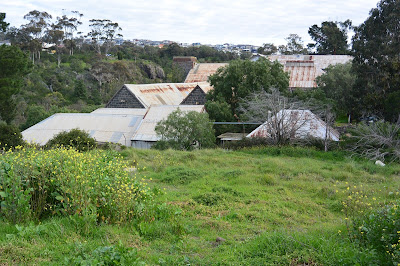
Looking south west from Button Hill towards the mill complex, August, 2016
Today the area is a large, overgrown, grassy paddock with little indication of its former purpose, however with some careful observation, we were able to locate a number of buttons, fastenings, metal objects and some scraps of material - all presumably discarded during the cleaning process.
Selection of buttons, fastenings and scraps on Button Hill, August, 2016
I don't believe that a detailed archaeological study of the site has ever been undertaken, but it would be interesting to know what these seemingly very ordinary buttons can tell us about the types of rags used. A couple of the buttons I found were stamped "EXCELSIOR" and "BEST SOLID EYELET". As far as I can tell, these were most likely buttons from men's pants. All the buttons were quite small and plain which is not surprising as I expect that any item of known value would have been removed prior to the clothing being consigned to the rag bag. Everything possible was recycled. Nothing was wasted.
Most of the buttons we found were metal, some were magnetic although most were not and may have been brass. There was one ceramic button, similar to those used on men's work shirts and a portion of a mother of pearl shell button. A third button may have been made from shell or a type of stone. All of these materials were commonly used in buttons during the 19th and early 20th centuries. There was also what appeared to be part of a shirt stud, commonly used on men's shirts instead of buttons as well as scraps of metal, leather and hessian.
The one thing I could not find whilst researching the role of women at the Barwon Paper Mill however, was a single account of the mill given by the women who worked there. There were numerous descriptions of what the women did and the conditions under which they worked, but I still do not know who they were.


06 June, 2015

From paper to paint - putting art through the mill

These days, recycling, re-purposing or even upcycling are all the rage and this can apply to buildings as much as any other obsolete item. Today, I had the chance (along with most of Geelong it seemed) to have a look at an historic building on the Barwon which is very definitely being re-purposed - and not for the first time.
Come one and all!
I speak of course of the paper mill at Buckley Falls. I have written about the history of the mill before here, so I won't go into too much detail, but in short, it opened in 1878 and operated as a paper mill until 1923. After this time, it spent some years in use as an ice factory before being commandeered for the war effort in 1941 as a munitions factory. After sitting idle for some time, the mill was bought fifteen years ago by a man with a plan - Alex Robins.
The Barwon Paper Mill buildings find new life
Over recent years, a number of small businesses have moved into the premises, including a wire fencing company, a mosaic artist and as of today, another art gallery. According to the Geelong Advertiser of 4th June, 2015, the long-term plan is to convert a part of the mill complex into an arts precinct with a function centre, restaurant or maybe even a boutique hotel along with some housing.
New fencing alongside old machinery
Mosaic art at the mill: Mosaic Commissions and Classes - All Things Mosaic
Ubu Gallery, opening of the Infernus exhibition by Cornelia Selover
And today, the mill was open for the public to come and explore. With other commitments for much of the day, I arrived about an hour and a half before closing time, to find dozens of cars still parked along the road as well as within the complex and many more visitors on site, all come to view this grand old structure. Much of the place is still in the condition it was left in all those years ago, with the bluestone carved from nearby quarries and locally-made bricks all very visible from both inside and out.
An interior view of an as yet unrestored section
Exterior stone and brick wall
Not only were the businesses on display, but the millrace was accessible too. It was interesting after so much time spent looking up, to see not only the race at close quarters, but also the view from above, looking down on the river. This end of the race is quite overgrown with ivy and other introduced species, but still holds water and appears structurally sound, 137 years after it first carried it to the mill.
The end of the millrace
The view from the opposite side of the river
The Chimney seen in the picture below, presumably provided venting for some of the coal-powered boilers at the mill. These were used for a variety of purposes, from powering equipment to producing the heat required for various steps in the paper-making process.
Chimney at the mill
Other vast concrete structures can also still be found in some areas. Presumably these also were part of the paper-making process, however I did hear it mentioned that these large vats were used for holding water for the ice-making during that era of the plant's history.
Now, having seen this new initiative for the mill it will be interesting to see how matters progress into the future and can be followed on Facebook.

22 September, 2012

A mill story!

Okay, enough of running for the moment! Time to get back to some local history with "a mill story" which for the record I am informed, is an old phrase referring to a piece of dubious gossip.
A couple of weeks back, I was involved in a very informative and extended exchange concerning flour mills in and around Fyansford and of course, the Barwon and Moorabool Rivers. For anyone interested, read this post and the comments attached thereto.
After quite a bit of scrounging through on-line sources, discussion and a little deduction my co-theorist and I reached some conclusions about flour milling in Fyansford in the mid-19th century.
The first problem we came up against in trying to sort out who owned what, when and where was the following statement which appears repeatedly on many sites, including some which should be relatively authoritative:
"In 1845 the first flour mill was erected by William Henry Collins on the banks of the Barwon."
Now, this statement is not as it turns out in and of itself incorrect. Collins did in fact open a flour mill on the Barwon in that year. The Union Steam Flour Mill. However, rather than being at Fyansford as is implied on various websites, this mill was located in Geelong next to where the Albion Woollen Mill was built, close to what is today, the James Harrison Bridge. This early flour mill eventually became the Union Woollen Mill which I have mentioned in a previous post. For the record, Collins also went on to establish the Collins Bros. Woollen Mill in the same area some years later.
Looking south towards the site of the Fyansford Steam Flour Mill,
September, 2012
All this however, is a separate issue to the Fyansford Steam Flour Mill which was built in the town of Fyansford.
This building was a 3 storey bluestone structure overlooking the banks of the Moorabool River. On 26th July, 1855, The Argus newspaper in describing Fyansford referred to "a very complete flour-mill". Records will show that the land on which the mill was built and the nearby Flour Mill House which still stands, were purchased by GJ Barthold at Fyansford's first land sales in 1854. Barthold and a business associate by the name of T Lowe appear to have run the mill until 1861 at which point they were declared insolvent and the mill sold. Exactly when this mill was built is not clear, but presumably it was not until the much later date of 1854 (not 1845) when Barthold bought the land.
To complicate things somewhat, by 1873 William Henry Collins to whom the building of the mill is wrongly attributed, was indeed the owner. In the Portland Guardian and Normanby General Advertiser of 25th July, 1873 refers to "his [Collins'] mill at Fyansford". Whether he purchased it in 1861 when Barthold and Lowe went bust I cannot determine.
According to the Victorian Heritage Database (which is one of those responsible for perpetuating the myth that Collins built the mill), following on from Collins' tenure, the mill passed through various hands, serving at one point as a dance hall before being demolished in 1930. The associated Mill House (pictured below) has however survived to the present day.
Flour Mill House, Atkins St, Fyansford September, 2012

All this is of course, not to be confused with the 5 storey bluestone Barrabool Flour Mill which was built in about 1851 (perhaps as early as 1849 if some sources are to be believed) by John Highett. This water-powered mill was situated on Mount Brandon Peninsula overlooking the Barwon River about 1.5km upstream of the confluence of the Barwon and Moorabool Rivers. It is about 1km from Fyansford as the crow flies  and on the opposite side of the Barwon.

The Barrabool Flour Mill, held by the State Library of Victoria
And for the sake of completeness, the Barwon Paper Mill and its associated water race both of which still stand today on the Barwon, were built quite some years later in 1875 and are located a few hundred metres downstream from Highett's flour mill and on the opposite bank.

06 June, 2012

What a difference a day makes

As of 4pm Wednesday the Barwon has not yet peaked in Geelong. The estimated time has now been pushed out to sometime tonight or early tomorrow but the water level is definitely rising. (Updated Thursday 7th June roughly as waterlevels peaked just below the minor flood level of 2.5m, see photo below.)
Old Breakwater Bridge, Tuesday 5th June, 2:45pm

Old Breakwater Bridge, Wednesday 6th June, 1:45pm
Old Breakwater Bridge 7th June, 11:50am at peak water level

The 2 top photos were taken about a day apart, the latter just as VicRoads was preparing to close the bridge to traffic.
VLine train crossing the flooded Barwon River
I also took the opportunity to take some photos which I doubt have been seen before as the new Breakwater Bridge endures its first flooding event.
Rail bridge and Old Breakwater Bridge in flood 6th June
as seen from the new bridge
At other points along the river through Geelong, things were also progressing as they usually do. Below is the view from Queen's Park this afternoon:
Queen's Park in flood from above
Elsewhere, the path opposite the rowing sheds was under water by this morning, the mill race at the paper mill was overflowing:
The paper mill at Buckley Falls
and a little upstream, the Bunyip Pool was well on the way to becoming a turbulent mass of water:
Water levels rising at the Bunyip Pool, 6th June, 2012
I also noticed that the resident bird life has been quick to take advantage of what I assume is an increase in available food sources as insects and perhaps even fish are driven from their normal homes.
One of a pair of pelicans catching breakfast in the shallows of the
flood waters this morning near the Moorabool Street Bridge

Mudlark with an insect driven out by the rising waters
As of Friday morning, water levels are receding. As predicted, the river peaked in Geelong around midday Thursday  at 2.42m just below the minor flood level (2.5m). Earlier predictions of about 2.8m were not realized.
Whilst this is by no means a record-breaking flood event, there are still some interesting statistics which have arisen from the recent weather. The Geelong Advertiser carried an article today which pointed out that the rain which fell between Sunday afternoon and Tuesday (about 61mm) was the largest in a 3 day period in June since 1952, which it will be remembered, was the year of Geelong's "great flood". The rainfall on Monday also approached the record for the single wettest June day on record which occurred on 1st June, 1939.
However, with no further significant rain forecast for the present, river height records of the past are safe for now.

02 July, 2011

From Rags to Riches or Just Milling Around?

Nor was wheat-milling the only industry to spring up along the banks of the Barwon. In 1876 as I mentioned in my previous post, a paper mill was in the process of construction on the north bank of the river at Buckley Falls.
Barwon Paper Mill at Buckley Falls during flooding
16th January, 2011
On the opposite side of the river from the old wheat mill, this new enterprise - the Barwon Paper Mill - drew its power from a channel running along the northern bank from Baum's Weir to the mill buildings below the Bunyip Pool at Buckley Falls. Unlike the wheat mill on the south bank, the paper mill and the complex of buildings which were associated with it, are still remarkably intact and as such are one of the most significant surviving examples of 19th century industry in the country. It is also one of the earliest and longest running examples of paper-milling in Australia and was operational until 1923.
At the time of its opening, the complex was at the forefront of paper-making technology and its backers included such notable Geelong names as Silas Harding, James and Andrew Volum and William Francis Ducker. A more detailed discussion of the technology involved can be found here.
The mill buildings themselves were constructed from bricks and locally quarried bluestone with corrugated iron and the equipment was powered by a water turbine wheel whose performance was enhanced by an impeller housed in a tower which can still be seen facing onto the river. Likewise, the water race is clearly visible carrying water from the weir along its full length until it reaches the mill where in times of adequate supply, it tumbles down to the rocks below and back into the river.
Water race running to the Barwon Paper Mill during drought
January, 2010
These mill buildings and their associated machinery were designed and built by the engineer Andrew Millar. The six workers' cottages and manager's house which also form part of the complex were designed by the Geelong architect Joseph Watts a couple of years after the original buildings in 1878. The cottages are the earliest example of company housing to be built in this state. They are still occupied as private residences and if the noises I heard last week are anything to go by, at least one is currently being renovated.
Originally, they were used to house some of the 200 men whom it is estimated, worked in the mill, making over 40 different types of paper.
Unlike today, paper-making processes in the Victorian era - and for 2000 years beforehand - relied on the pulping of old rags, rather than that of wood fibres and the Barwon Paper Mill was no different in this respect. The rags went through a number of treatments designed to break the fibres into small enough pieces to be formed into paper.
A curious side effect of using rags, was the need to first remove any old buttons or fastenings which may still be attached to the cloth. This task was undertaken by women whose job it was to sit and remove the unwanted attachments. Once removed, the buttons were simply dumped in a pile near the mill site. It was this practise which gave rise to the name Button Hill for the land which rises to the east of the mill. According to descriptions by the Victorian Heritage Database, there are hundreds of thousands of buttons, beads and other clips and fastenings on the hill made from bone, ceramic, glass, metal and other substances. The site is located partially on private property which does not belong to the mill and currently still awaits comprehensive archaeological examination.
Mill cottages built in 1878
 In 1888, upon the death of Captain James Volum, one of the principal proprietors, the partnership dissolved and the complex was sold to the Victorian Paper Manufacturing Co Pty Ltd who in turn on-sold it in 1895 to the owners of two other paper mills in Melbourne and Broadford. The three mills were then run jointly under the name of the Australian Paper Mills Co. Ltd.
After paper production ceased, the complex was taken over for the manufacturing of ice before being commandeered in 1941 for use by the navy during World War II. Nowadays, the mill is privately owned and whilst no longer used for its original purpose, the buildings are utilised by a number of small businesses which operate out of the site. Unfortunately for those of us who are interested, this has the disadvantage of excluding access by the general public to the mill complex. So, for the present we will have to continue as I have done for several decades now, to view the mill from the south bank of the river.
Well, that was, until today (6th June, 2015). See this post.