Showing posts with label Willie Wagtail. Show all posts

12 December, 2012

Oh baby!

Well it is certainly that time of the year and having just hosted two kids' birthday parties I know how the various feathered denizens of the Barwon must feel!
Now that I can actually get back to the river without the need of walking aids, I've been able to cover a bit of ground - although not as far or as fast as I'd hoped during this morning's rather warm run. The most obvious seasonal change I've noticed is the explosion in the bird population which has resulted in a number of rather cute photo opportunities which are the justification for this post.
Firstly I noticed a couple of Dusky Moorhen chicks at Balyang Sanctuary a couple of weeks back, but headed back today to take some clearer shots:
Dusky Moorhen mother and chicks at Balyang Sanctuary
 There were several different pairs of birds, each with up to three chicks.
Next I came across a White-faced Heron chick and a pair of Pied Currawongs nesting not far from Barwon Valley Golf Course (photos of these are on the Birds Nests page).
During a ride last week-end I came across a family of Australian Wood Ducks beside - appropriately enough - the duckpond at Queen's Park.
Australian Wood Duck family
They weren't overly impressed by my arrival and rapidly headed for the opposite side of the pond. A few weeks earlier I saw an older brood who were paddling about opposite the boatsheds, however I haven't seen them of late.

More Australian Wood Ducks
This afternoon I also came across a number of impending parents including a Sulphur-crested Cockatoo and a neighbouring pair of Long-billed Corellas who had each set up home in different branches of the same large eucalypt at Balyang Sanctuary (again, see the Birds Nests page). Actually, I was interested to see the cockatoo was present. During an earlier visit, at which time it was presumably looking to secure some spacious family accommodation, it appeared to be facing some stiff opposition from a scouting party of bees, who indeed may have felt they had some prior claim as this particular hole was used as a hive in a previous season. The cocky didn't seem too perturbed and just shook its head when the bees got too close or perhaps when the buzzing in its ears became too loud. Today there was not a bee in sight.
Not far away a pair Mudlarks was sharing adjacent branches with a couple of Willie Wagtails who predictably spent quite some time trying to convince me that their nest was nowhere nearby.
Willie Wagtail nesting on the Barwon at Balyang Sanctuary
Of course I have both seen and heard various other young birds over the last few weeks and have also seen a number of as yet unidentified nests. With any luck I'll be able to snap a few more pics and find out who's living in those nests!


04 August, 2012

The shepherd's companion - an update

On the 28th April, I posted about a Willie Wagtail nest which I had been watching near Baum's Weir. The birds were very busy over the summer months, but then when I returned in April, the nest was empty and the birds had moved on. Yesterday, I went back for another look to see a) what had become of the nest and b) whether there was any sign of the birds.
Willie Wagtail and nest, November, 2011

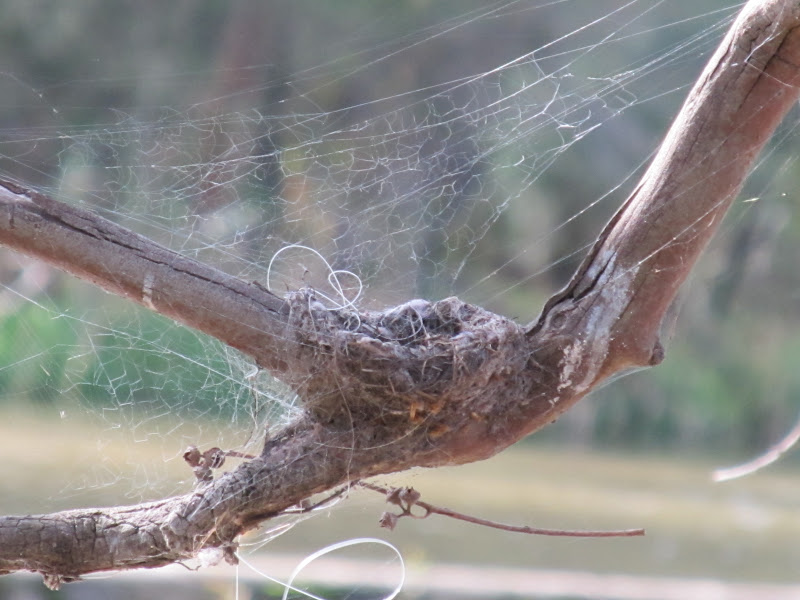
Willie Wagtail nest, April 2012
Willie Wagtail nest, August, 2012
Well, the remains of the nest were still in evidence, along with the fishing line and the twig, however it was looking even worse for wear than in April and there was no sign of the birds, in fact I did not see a Willie Wagtail the entire time I was there. Another change I noticed was that the spider who had taken up residence had either changed or undergone a serious alteration in web-spinning technique. April's web was less symmetrical and roughly triangular whilst the current web is far more regular and a more typically rounded shape.
Whilst the Willie Wagtails were absent, in contrast to my last visit, the cuckoos were very much in evidence. Whilst I could not see it, I could hear at least one Fan-tailed Cuckoo quite clearly from the moment I arrived. After snapping my shots of the nest, I headed a little further downriver and was rewarded with the following photo:
Brush Cuckoo near Baum's Weir, August 2012
The Brush Cuckoos it appears have also returned to await the arrival of the Willie Wagtails....

28 April, 2012

The shepherd's companion

In the latter part of 2011 I made a few forays up the Barwon to the somewhat grandiosely named Mt. Brandon Peninsula. The results of my travels appeared in some of my previous blog posts. In particular, I spent some time photographing a nest belonging to a pair of Willie Wagtails.
Willie Wagtail and its nest, November, 2011
Yesterday, I headed back to Baum's Weir and the peninsula to see what was new. Everything was much as it had been before with the exception of a few dropped branches and a couple of non-native trees which were well into the swing of autumn. I did see several European Goldfinches past Baum's Weir and up on top of the peninsula as well as a flock of Flame Robins. This was the first time I'd seen either on the river.
I also went back to investigate the nest belonging to the Willie Wagtails. What a difference a few months can make. When I last visited the nest in November, the Willie Wagtail breeding season was well under way. It generally lasts from August to February and can involve the rearing of several broods of chicks.
Willie Wagtail in its nest, November, 2011
At that time, the female was always in the nest when I arrived and as I mentioned previously, she and her mate were typically aggressive in defending their territory both against myself and on one occasion, against an unfortunate Crested Shrike-tit which happened to venture onto their branch. I have also seen a Willie Wagtail take on a kingfisher and I believe they are quite happy to argue the point with even larger birds, including kookaburras and Wedge-tailed Eagles.
Perhaps because of their gregarious behaviour and chattering calls, the folklore of indigenous cultures across Australia tends to describe Willie Wagtails as the bearers of bad news. They are recognised as intelligent but are thought to tell-tales and steal the secrets of humans, according to some tribes, informing the recently departed if their living relatives speak ill of them. I have not been able to discover whether the local Wathaurong tribes have cultural links to the Willie Wagtail, however they cannot have been unaware of these vociferous little creatures in their landscape. They may even have raided their nests for eggs as they are often located well within human reach.
As is clear from the above photos, the nest is a cup shape composed of grass, bark and other fibrous bits and pieces, all bound together with cobwebs. The inside of the nest is lined with hair, fur and soft grasses. No-one seems keen to tell me what the spiders think of having their webs commandeered by the Willie Wagtails, but then, it is also quite possible that the spiders themselves have become dinner and are in no position to complain.
This time when I arrived, there was no sign of the birds and the nest was clearly in a state of disuse, except - somewhat ironically perhaps - by a spider or two who seemed to be taking their revenge.
Willie Wagtail nest April, 2012
Looking at the nest in November and now, it seems there were some additions made prior to the departure of the birds and the arrival of the spiders. The large twig still with seed pods attached is a more recent addition, as is what appears to be a piece of fishing line. Hair is also evident. It would be interesting to know where the birds sourced their building materials as there are not a lot of houses and their domestic animals in the immediate vicinity nor are there herd animals to provide these fibres.
It is from their habit of closely shadowing sheep and cattle or even riding on their backs - presumably to catch the insects they stir up in their wake - that Willie Wagtails are known as the Shepherd's Companion. Presumably they also take the opportunity to pinch a hair or two at the same time.
 I also noticed another interesting detail during yesterday's walk.  In November, I saw a Brush Cuckoo in the same tree as the nest and also saw Fan-tailed Cuckoos nearby. Now that the Willie Wagtails are no longer breeding, I neither saw nor heard any sign of cuckoos.
Brush Cuckoo in the vicinity of the Willie Wagtail's nest November, 2011
This is probably no coincidence as I discover that various species of cuckoo, including these two, will attempt to place their eggs in the Willie Wagtail's nest. The wagtails however, often recognise the impostor and remove it from the nest.
When summer and the nesting season end, the cuckoos - presumably realising the gig is up - depart for more northerly climes. The Willie Wagtails by contrast, hang around until it is time to start the whole process again.
As Willie Wagtails generally pair for life and are known to reuse nests, or to recycle old materials in building a new one, I will be keeping an eye out to see which - if either - happens with this nest and the birds who built it.


04 February, 2012

Blue and green

Well, it has been over a week since sections of the Barwon were closed to the public due to an outbreak of toxic blue green algae and far from improving, things seem to be getting worse! There has been little rain to speak of during the week and temperatures are hotting up again for the weekend.
As a result, the river has now been closed as far downstream as the breakwater and the green goop continues to spread. I had the chance to have a look at the section from Breakwater up to Fyansford during a run and walk yesterday (Friday) and whilst it doesn't look too much different at the Breakwater end, the section upriver from Queen's Park is currently a dozen different shades of green.
Blue green algae in the Barwon River above Queen's Park
I returned this afternoon with camera in hand to snap some more shots of the spreading scourge and hopefully of a little kingfisher I spotted on my way past yesterday. Both aims were fairly quickly achieved. The Barwon up to the confluence with the Moorabool River (as far as I went on this occasion) has a distinctly greenish tinge to it and will do for some time I am told.
Blue green algae at Queen's Park

Blue green algae
Around Queen's Park the algae is currently flowing slowly past in clumps and swirls and threads of green, aqua and every shade in between. There is one aspect however, which does not translate into a blog post, and that is the smell. It is in places - to say the least - unpleasant and gives a very particular scent to the air.
But enough of algae. I headed a little upriver and soon managed to find the kingfisher by virtue of the fact that it was being roundly chastised by a willie wagtail.
Willie Wagtail and Sacred Kingfisher
It didn't seem too concerned by this and perched on a branch and watched me take my shots. We then proceeded to play chasey amongst the trees whilst I attempted to find just the right angle. At one point it swooped down to the surface of the river after some prey in a flash of blue wings against green water.
Sacred Kingfisher near Fyansford

Sacred Kingfisher near Fyansford

Eventually I headed a little further upriver to take more shots before turning back. I was keeping an eye out for the kingfisher but would have walked straight past, had it not chosen precisely that moment to sing. We then played another short game of hide and seek before it took off for a dead tree on the opposite bank. Given the current state of the river, I had no intention of following and continued on my way downstream.

18 November, 2011

Birds of a feather...

At the present point in time, I have so far managed to observe and photograph ninety-nine different species of birds along the length of the Barwon River. Today, being without a car for part of the day, I decided to take an extended walk from the James Harrison Bridge in town, upriver to Buckley Falls and around Mt Brandon Peninsula past Baum's Weir and back.
The weather was quite hot and windy with a storm brewing, so I was almost convinced that most of the bird population would have taken to their nests or disappeared to whatever place it is that birds seem to go when it's windy. That didn't appear to be the case today however, as the feathered population which lives along the banks of the Barwon was out in force allowing me to spot fifty of those ninety-nine species.
I didn't add to my tally of new bird discoveries during the course of the day, but I did snap quite a few shots so I thought I would use this post as an excuse to upload a few of the better ones.
Willie Wagtail nesting near Baum's Weir
The Willie Wagtail shot is one I've been taking versions of for a few days now that I know where the nest is. When I arrive, the bird usually leaves the nest to tell me in no uncertain terms to keep my distance. It then watches me for a couple of minutes before hopping onto the branch and back into the nest.
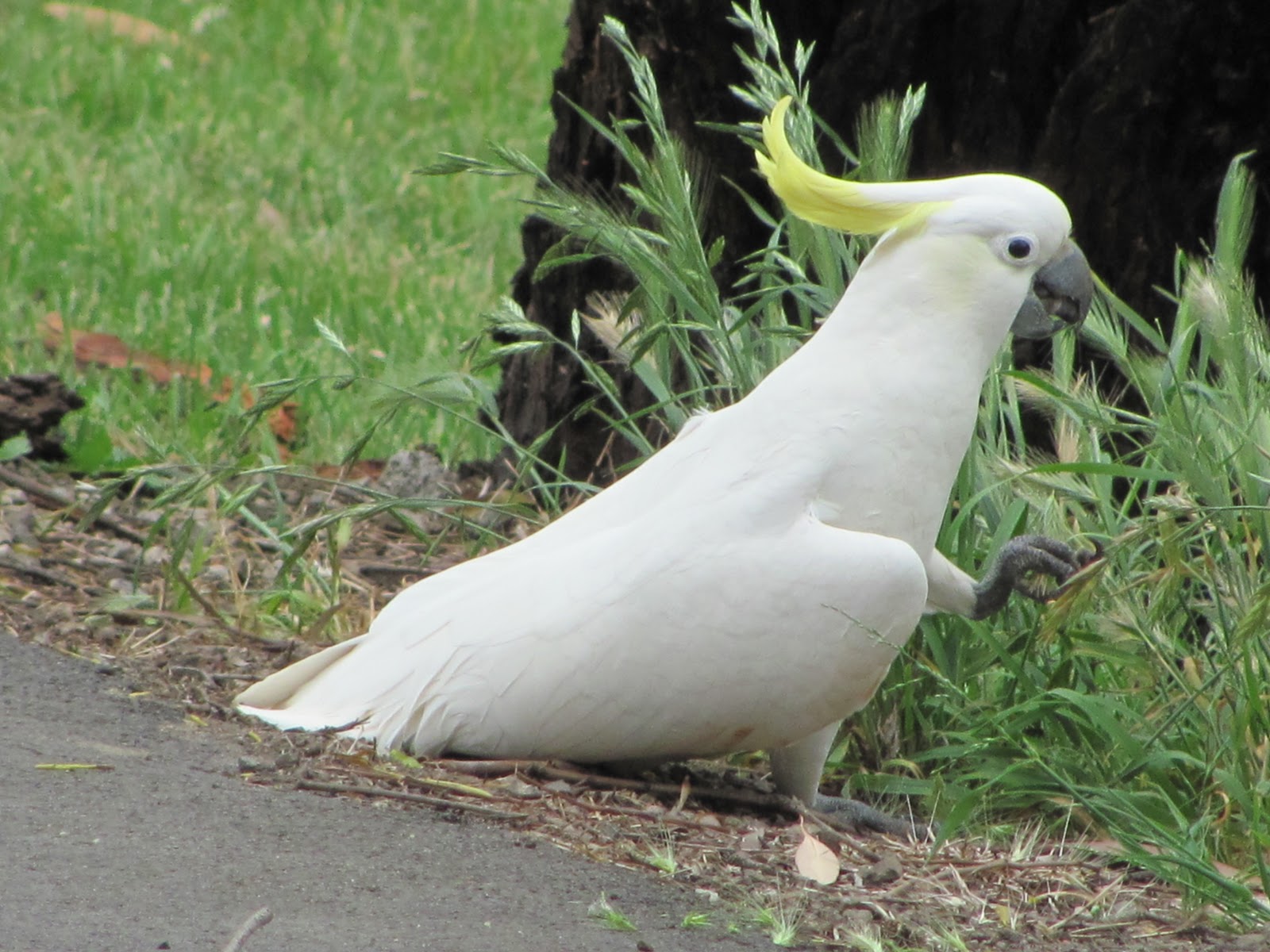
Sulphur-crested Cockatoo
This little guy near Queen's Park was helping himself (and yes, based on eye-colour I think it is a he) to seeds from the grass at the side of the track. He was not even vaguely concerned by my presence or that of the cyclist who passed just after I took this shot.
Male Hardhead Duck aka White-eyed Duck
This rather intense-looking male Hardhead Duck was paddling around in the midst of a bunch of
Pacific Black Ducks at Balyang Sanctuary and trying unsuccessfully to look like one of the gang.
Little Black Cormorant

Great Egret
The fishermen of the bird world seemed mostly to have exchanged the lower weir at Buckley Falls for Baum's Weir today, as the above egret and cormorant were accompanied by a Nankeen Night Heron who was also fishing off the edge of the weir. It would appear that no-one has seen fit to inform the "night" herons on the Barwon that they are supposed to feed at night as I have regularly seen them on the hunt during daylight hours of late.