Following on from my previous post
Anticipating the Octopus Act, I thought it might be interesting to look at the route finally chosen for the Geelong-Ballarat railway line and to use some of those photos I've been saving for just such a post. So here it is:
After the opening of the rail link between Melbourne and the growing township of Geelong (population 23,352) in 1857, tenders were taken and in 1858 construction began on the Geelong-Ballarat railway line. The chosen route branching off the Melbourne-Geelong line at North Geelong did not cross the Barwon River as at least one proponent had suggested, instead, it crossed the Moorabool River by means of the the
Moorabool Viaduct located about 1.5km west of the Geelong-Ballan Road.
 |
| The Moorabool Viaduct 1863 |
The line was officially opened on 10th April, 1862, following the route we know today. It remained the only rail link from Melbourne to Ballarat until 1889 when a direct line between those two cities was opened.
The 86km of line from Geelong to Ballarat was built to the highest engineering standards of the day and in addition to the viaduct, included a number of bridges crossing roads and creeks.
 |
| Rail bridge near Moorabool station |
Not surprisingly given that the line passes across one of the world's largest volcanic plains, the predominant building material was bluestone, examples of which can still be seen right along the line.
 |
Double-arched bluestone bridge carrying the Geelong-Ballarat rail line across
Cowies Creek and Bluestone Bridge Road at Lovely Banks |
Stone for the construction was quarried at Lethbridge, which township the line passed en route. During construction of the Lethbridge section of the line, workers lived in tents at two camps along the line. One was located a few hundred metres north of Lethbridge station. The other, about 3km south and a little east of Lethbridge, was situated on the banks of Bruce's Creek (a tributary of the Barwon River) just to the south of a bluestone rail bridge which crossed the creek on the property owned by my grandfather (Jack Stevenson) about a century later.
 |
| Lower Camp Bridge, outside Lethbridge |
Today I took a walk up the line from Lethbridge Station and snapped some photos.
The bridge was known to locals as Lower Camp Bridge, presumably after the men who built it. Rivalry between the two camps was strong, both on the sporting field of a Sunday afternoon and in their bridge-building prowess. Attention to detail can be seen in the finish of the stonework on the bridges near Lethbridge. Perhaps I'm biased, but the detail of the Lower Camp Bridge does seem somewhat greater.
 |
| Road bridge on Quarry Road, Lethbridge |
 |
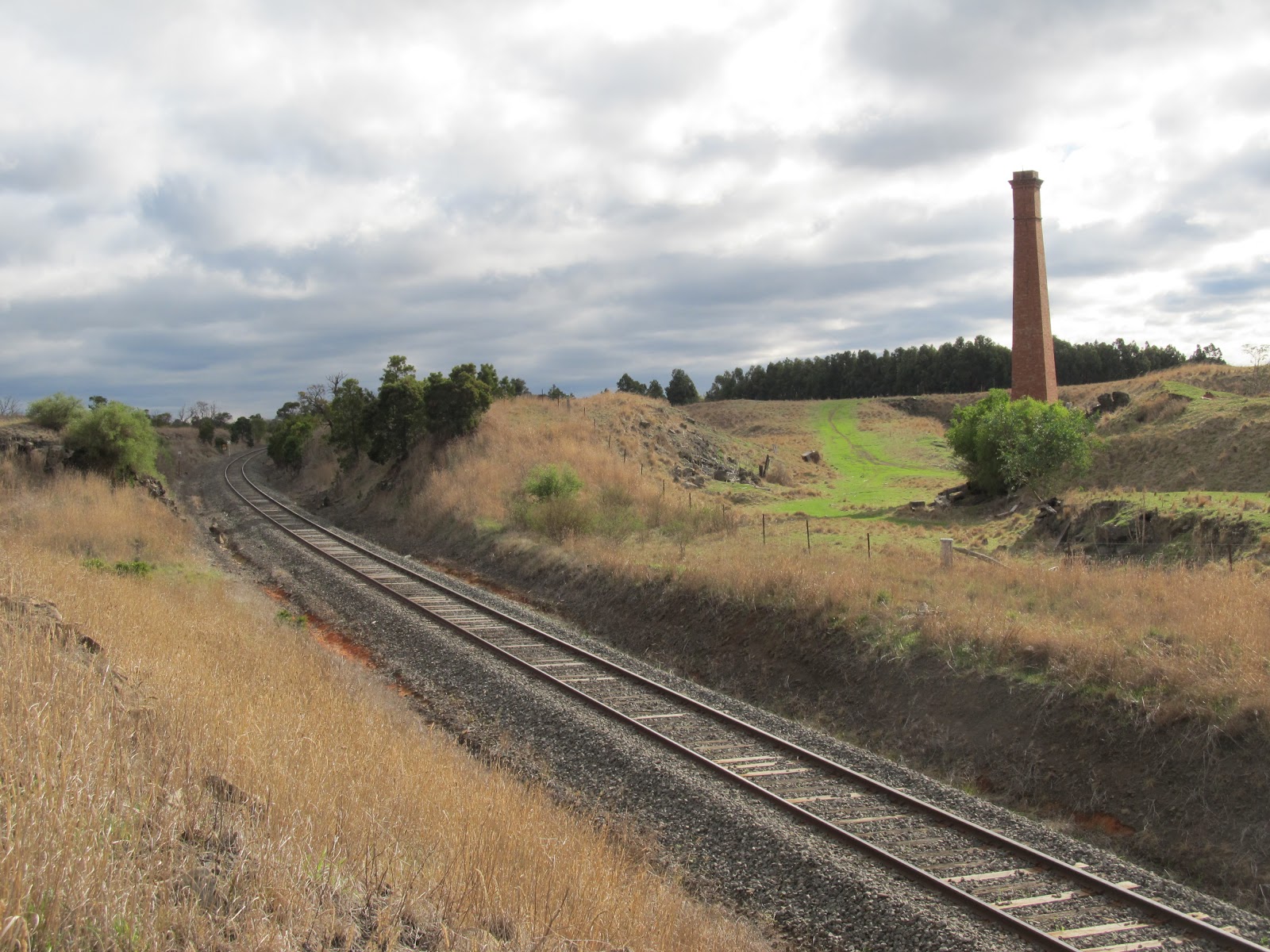
Remaining chimney at the quarry from which stone was cut for the
Geelong-Ballarat railway line (later Nash's Quarry) |
 |
| Rail bridge over O'Connor Road, Lethbridge |
By comparison, the bridge across Bruce's Creek on Russell Street in town is a much simpler construction. Whilst not part of the railway infrastructure, it was built by the railway to allow access to their works.
 |
| Bridge over Bruce's Creek on Russell Street, Lethbridge |
Initial stations - also of bluestone - were erected along the line at Moorabool, Lethbridge, Meredith, Lal Lal and Yendon (Buninyong). Later stations were added to the line at Geringhap, Bannockburn, Elaine, Navigators and Warrenheip. The stations at Moorabool, Bannockburn, Lethbridge, Meredith and Lal Lal remain standing today:
 |
| Moorabool Station April, 2012 |
 |
| Bannockburn Station April, 2012 |
 |
| Lethbridge Station April, 2012 |
 |
| Meredith Station April, 2012 |
1The Geelong-Ballarat railway celebrated its 150th anniversary in April, 2012 with an open day and special vintage rail service. Freight traffic for Mildura continues to travel via the Geelong-Ballarat line however, passenger services were suspended in 1978. A recently concluded study looked into the feasibility of re-introducing a rail passenger service between Geelong and Ballarat, extending to Bendigo via Maryborough and Castlemaine. It was estimated that such a project would cost almost $1 billion to implement with ongoing running costs of $17 million per year and was unlikely to receive funding however, some within political circles are not quite willing to write the subject off just yet, pointing out that figures for the Geelong-Ballarat section of the line alone may be more economically viable...