Showing posts with label Steiglitz. Show all posts

20 April, 2016

Making tracks: decisions! Decisions!

Over the past six months and 21 blog posts, I've followed in the tracks of the gold diggers making their way from Geelong to Ballarat, looking at how they travelled, where they travelled, who they might have met along the way and what conditions they faced. The aim was to decide which - if any - of the various tracks was the "main" route to the goldfields - a claim made of each of these tracks at one time or another.
Google Earth image showing the likely routes via Shelford (red),
the Geelong-Buninyong Track (green) and Steiglitz (blue)
Teesdale it is claimed at a local park lay on the "main gold route". The Eclipse Inn north of Steiglitz was situated on the "best line of road" to the goldfields, boasted a real estate agent in 1853. A report by the Victorian Heritage Database states that "later the Warrenheip Road to Ballarat became the main gold fields route from Geelong", whilst in 1943 a local resident of the town of Meredith recounted that "when gold was first discovered at nearby Buninyong, Ballarat, Steiglitz and Bendigo, most of the traffic to those places started from Geelong and came through Meredith by bullock teams along bush tracks."
Even Skene St in the Geelong suburb of Newtown was claimed as part of "the main route to the Ballarat goldfields" - presumably a reflection of the flow of traffic west towards Fyansford and across the Moorabool River to the Geelong-Buninyong Track near the future site of Gheringhap.
The one thing which does seem clear is that each claim had its own angle: the best road, the main route, the most traffic, a particular point in time. What is clear however, is that over the years, huge amounts of traffic flowed along all routes to the goldfields of Ballarat. But were all the routes equivalent?
Store drays camped on road to Ballarat, TS Gill, 1855, Image held by the
National Library of Australia
Well, the distance of each was not the same. The journey from Geelong to Ballarat via the Geelong-Buninyong Track and the Plank Rd was around 50 miles (80km). From Geelong via Steiglitz and Warrenheip to Ballarat was about 59 miles (95km) whilst the track via the Leigh Rd to Shelford and then to Buninyong and along the Plank Rd was also around 59 miles. If travelling via Magpie Gully instead of the Plank Rd, then an extra mile or more could be added to the journey.
A difference of 9 miles or 15km is not so much on modern roads with fast cars, but to a digger walking the distance, this could amount to almost half a day's extra walking. If however, a dray were to become mired in Scott's Swamp, not only hours, but days could be lost, not to mention the potential for broken wheels and axles, the loss of an expensive horse or bullock or even the significant physical exertion required to unload and reload an entire dray full of supplies in order to lighten the load and escape the bog. As a result, whilst the shortest route may appeal to those on foot, road conditions may have been more important than distance to those travelling by vehicle.
To complicate the issue further, there were any number of alternate routes and tracks connecting each of the three roads running north-south. From the Steiglitz road it was possible to cross the Moorabool River and reach the Geelong-Buninyong Track via the Melbourne-Buninyong Rd intersecting at Green Tent, Sharp's Crossing which intersected at the same point, the Steiglitz-Meredith Rd and at least one other unnamed crossing to name a few.
From the west, it was possible to cross the Leigh River at 'Narmbool' and possibly also at an informal crossing near Bamganie. Today, a number of small fords cross the Leigh on private property, presumably it was no different in the 1850s. In a time when a bad track or tricky creek-crossing saw travellers take to the bush, forging their own path, it is not surprising that informal tracks and crossings proliferated.
Google Earth image showing the interconnecting tracks between Geelong and Ballarat. Red
lines show tracks marked on survey maps, blue lines show approximate routes described, yellow
lines show likely connections along and between routes using modern roads, green lines
show estimated routes based on surveyor's field books. Early inns along the routes are also shown.
Click to enlarge
Another important factor was date. When the gold rush first broke out in August, 1851 everyone wanted to be at Hiscock's Gully. Two weeks later, after the discovery of Golden Point, they were also flooding to Ballarat along the Geelong to Buninyong Track. The surface alluvial deposits however, were quickly worked out and within a short time, deep lead mining became common. As the miners followed these leads, mining activities spread out across the Sebastopol Plateau following the course of an ancient river underlying the Leigh. It makes sense that anyone travelling to these mines during the 1860s would consider travelling via Shelford.
At Steiglitz, the discovery of quartz reefs in 1855,  drew traffic from Geelong and also from Ballarat, presumably making the route from Geelong to Ballarat via Steiglitz and Warrenheip more appealing at that time. This road also provided access to other nearby goldfields such as Mt Egerton, Dolly's Creek and Gordon to name a handful.
Despite all of this however, it is worth remembering that coaches - including Cobb & Co.'s famous Leviathan Coach capable of carrying 89 passengers - continued to run directly between Geelong and Ballarat along what soon became the Geelong-Buninyong Rd. After the discoveries at Steiglitz, extra services ran via Hope's Bridge over Sutherland's Creek to the town, however coaches from Steiglitz for Ballarat still travelled via Meredith, Buninyong and Magpie Gully, rather than the Eclipse Inn and Warrenheip. A comparison of distance shows the coach route to be only a mile or so shorter than travelling via Warrenheip. I cannot see any mention of a coach service via Mt Mercer throughout the gold rush period, however the Portland Bay service from Geelong did pass through Shelford, Cressy and Fiery Creek further to the west.
Cobb & Co.'s Leviathan Coach, c1862. Image held by the Victorian State Library
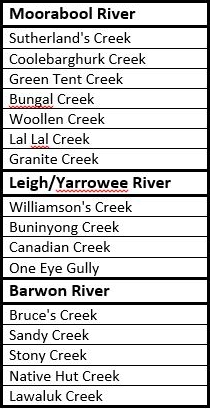
Regardless of which route the diggers chose, one thing was certain: at some point they would have to cross, walk alongside or take water from the the tributaries of the Barwon River. Whichever route they chose would require not just one, but numerous creek and river crossings. Whether at Batesford, Fyansford or east of Buninyong, the Moorabool River had to be crossed. Travelling via Shelford also meant crossing the Leigh/Yarrowee River at least twice, if not three times, not to mention the many creeks and gullies along the way. Below is a list of the main creeks along the three routes, grouped according to the river into which they flow.
In the early days before bridges were built, fording creeks and rivers was inevitable and bad weather could have a significant impact, not only on the road surface, but also on the ease with which a creek or river could be crossed - if it could be crossed at all. Newspaper reports of flooding often also came with reports of drownings, both of animals and humans as attempts were made to cross dangerously swollen creeks and rivers. Another reason for diggers to consider carefully which route to take.
There is one other factor which could also influence the decision and which could significantly alter the flow of traffic along a particular road: maps.
And some of those maps will be the topic of my next post.

13 April, 2016

Making tracks: the best line of road

Twenty-eight Miles from Geelong, near the Moorabool River, and on the best line of Road to Ballarat.
This was the rather bold claim made in September, 1853 by real estate agent J.B. Hutton who had been retained by Richard Coombs to sell the Eclipse Hotel, located some three and a half miles to the north of Steiglitz at the end of what is now Eclipse Rd. The Eclipse - as I have mentioned previously - was 'Durdidwarrah' (now 'Darra') the former homestead of Charles Augustus Von Steiglitz. It had been purchased by Richard Coombs who,  in April, 1853 stated that "Owing to the increasing traffic on this road, the want of accommodation has been so much complained of that a half way house has become a matter of necessity..."
Coombs further claimed that "the distance to Buninyong by this route is considerably shorter than by any other...[and that] the road having been the great thoroughfare in the winter season, notwithstanding the want of accommodation, proves the superiority,which is admitted by its now being generally taken by parties to and from the diggings."
Eclipse Rd between Steiglitz and 'Darra'
Clearly, by 1853 diggers were travelling to the goldfields at Ballarat and Buninyong via Steiglitz and the suggestion was that this road was a surer bet during the wet winter months when sections of the Geelong to Buninyong Track became all but impassable. It was also claimed that this route was "considerably shorter" than "any other", however I'm not sure this claim can be supported. The trip from Geelong to Steiglitz alone was around 40km (or around 25 miles in the old units). If the second half of the journey followed the route I suspect it did, then a further 51km (31 miles) would be required to complete the trip. A total of around 90km (56 miles).
By contrast, the total distance from Geelong to Buninyong via the track of that name was around 80km (or 50 miles) in total. Various newspaper articles over the years however, indicate that travellers were prepared to travel quite some distance out of their way to avoid bad roads, so whilst perhaps not the shortest route, it may well at times - like the track via Shelford - have been the easier, if not also the safer route to take.
Despite his grand plans, Coombs' tenure as landlord of the Eclipse was short-lived. By September, 1853 the property was once again on the market and in March the following year, was purchased by Mr William Birdsey, along with 33 acres of land and a number of outbuildings. Subsequent nearby land sales made the claim that the land stood on "the northern road to Buninyong and Ballarat", although the northern road from where, it did not state.
'Island Lodge', the home of Charles Augustus Von Stieglitz on his Durdidwarrah
Run, later the Eclipse Hotel. Image held by the Victorian State Library
Whilst perhaps not the main route to the goldfields, traffic during the 1850s would have fluctuated with the discovery of gold at places like Morrison's and Dolly's Creek. Although initial finds in these areas occurred in 1851, prospecting did not really take off until around 1857. Prior to this however, in 1853, the discovery of gold at Mt Egerton, almost 30km to the north of Steiglitz would also have resulted in an increase in traffic.
After quartz reef mining at Steiglitz took off in late 1855, traffic at least as far as Steiglitz would have increased dramatically too, and for those who could afford it, in March, 1856 the Criterion Conveyance Company indicated that they would be running a service from Geelong to Ballarat via Steiglitz, Meredith and Magpie Gully. By contrast, I can find no indication that a coach service operated between Steiglitz and Mt Egerton. It does however seem likely, that the route was popular with drays coming from Geelong. During a flood in October, 1855, it was noted that due to the water level of Wallace's Creek, dray communication between Egerton and Geelong via Steiglitz was at a virtual standstill.
I am unsure whether this route from the Eclipse to Buninyong has been documented elsewhere, but looking at the survey maps available online and considering a few relevant dates, I suspect I now have an idea of where this "northern road" ran and why it was used. Like the other tracks and roads which spread out across the countryside, this route was probably part of the network of bullock tracks which criss-crossed the countryside, leading from one squatter's run to the next.
The track to and from the Eclipse Hotel would originally have led to Charles Von Stieglitz' Durdidwarrah Run and after passing by the homestead continued north past Mr Hugh Morrison's pre-emptive selection at 'Moreep' to that of John Wallace of 'Ballark'.
Plaque at the Molesworth Bridge acknowledging John Wallace of 'Ballark'
An 1856 survey map of the Parish of Ballark shows a bush track running north-south and labelled as the "bush track from the Steiglitz". It intersected a second east-west track at the south east corner of Wallace's pre-emptive selection. This second "bush track to Geelong" closely followed the modern Meredith-Ballan Rd to its intersection with the Egerton-Ballark Rd around 800m to the east (see map below) before continuing east and then south east to intersect with the Geelong-Ballan Rd. It is also of interest to note that today's Bungeeltap South Rd was - according to the survey - originally intended to be the main Geelong-Ballan Rd.

A section of the 1856 Ballark Parish survey map overlaid on Google Earth.
The red lines show the bush track from Steiglitz and that from Geelong
Unfortunately, at this point the early maps online dry up, so I can only assume that the track roughly followed the Egerton-Ballark Rd through Wallace's pre-emptive selection, crossing the east branch of the Moorabool River and heading north west between the two branches of the river. I can find no mention of the river crossing itself, except perhaps the above reference to "Wallace's Creek" being so badly flooded that drays could not cross. It is possible - although I cannot confirm it - that this section of the Moorabool East Branch was known locally as Wallace's Creek at that time.
The Moorabool River East Branch at the Molesworth Bridge
 Regardless, a quick glance at Google Earth at this point will reinforce the Egerton-Ballark Rd as the most likely route north. The road can be seen to run along the ridge between the Moorabool West Branch and Bungal Creek. Travel on either side of these streams would be seriously restricted by some fairly hilly and inhospitable terrain in the form of the Mt Doran and Lal Lal State Forests to the west and the Bungal State Forest to the east, making the middle ground the more appealing option. A correspondent to the Bendigo Advertiser travelling south in December, 1855 described the route he took as passing the stations of Lal Lal, Egerton and Wallace which is also consistent with the above route.
Looking north west across the Moorabool East Branch near 'Ballark'
After traversing the high ground between the two waterways, I was again able to pick up the trail at the Yendon-Egerton Rd. This road - like many others in the area - follows an earlier track which is marked on an 1855 survey map as "from Lal Lal" at one end and "to Geelong" at the other. I cannot tell from the map whether the "Geelong" end continued to the west, or turned south, becoming the "missing" section of track from 'Ballark', however, to the west, the section of track shown on the map turns slightly to the north, as does the modern road, and crosses the Moorabool West Branch at the site of the Blue Bridge. Whilst the bridge may only date back to 1870, clearly the crossing was in use much earlier, probably dating back to the earliest days of European settlement, and if other sites are any indication, it may even have been used as a crossing by the local Tooloora balug clan of the Wathaurong who lived in the area.
Moorabool River West Branch, looking east towards the Blue Bridge
on the Yendon-Egerton Rd, October, 2013
Once across the river, the diggers found themselves on the Lal Lal Run, by that time in the hands of Archibald Fisken who by 1850 had taken over the property from his uncle Peter Inglis. At this point however, things become less clear. The early survey maps of Buninyong Parish show a bush track running to the north of Mt Buninyong, closely following the modern Yendon Number One Rd to Buninyong Rd and then intersecting the Midland Highway about 250m west of the present intersection.
It is not too much of a stretch to imagine that the track from Steiglitz, after crossing the Moorabool, continued through Fisken's property to become the track leading into Buninyong. Before the gold rush of course, Buninyong developed as a hub where those from the surrounding squatting runs could buy supplies without having to travel all the way to Geelong or Melbourne. No doubt the Peter Inglis and Archibald Fisken and their men made good use of this track to Buninyong over the years.
After the discovery of gold at Golden Point in 1851 however, the majority of traffic headed not for Buninyong, but further north to Ballarat where they would find themselves in the midst of those who chose to travel directly from Melbourne. For the latter diggers, there were a number of tracks which developed, the remnants of which can still be seen in some of the road names today. Most relevant to this post is the Old Melbourne Rd which runs from Ballan through Gordon, Millbrook and Dunnstown to Warrenheip. From at least the 1860s, this road was known as the "South Melbourne Rd to differentiate it from the more northerly road which followed a line to the north of
The track was typical in that after the discovery of gold, a string of public houses sprang up along this road to cater for those heading to the diggings. One such was the Spread Eagle Hotel, located on the north east corner of William Bacchus' pre-emptive selection. In The Argus of March, 1856 it was described as a "well-known roadside hotel", suggesting it had been in operation for some time.
The hotel - and this section of the track from Melbourne - lay about 5km north of the river crossing from Steiglitz on Fisken's land and a road (still known today as Spread Eagle Rd), ran north-south between the track to Buninyong and the track from Melbourne to Ballarat. It appears on survey maps as early as 1858 and may have provided a route for traffic from Geelong via Steiglitz to merge with that from Melbourne.
Google Earth image showing bush tracks on survey maps (red), the Old
Melbourne Rd (green) and likely connecting roads in between (blue)
For those looking for a more direct route, or who perhaps were not in need of sustenance at the Spread Eagle, another road surveyed by the 1850s branched off the Buninyong track immediately after it crossed the Lal Lal Creek further west. This road travelled north west, aligning with the modern Dunnstown-Yendon Rd which intersects the Old Melbourne Rd west of Dunnstown. Unsurprisingly, only a short distance further along, another public house - Pedrana's Saw Mill Hotel - also sprang up at the foot of Mt Warrenheip, near the pre-emptive selection held by Archibald Fisken as part of the Warreneep Run. The name of this establishment appears in the newspapers from the mid-1850s where it was the scene of a murder which received substantial media attention at the time.
Some idea of conditions can be gleaned from a traveller from Ballarat to Melbourne in 1859 who gives the impression that perhaps the road was not all as good as Mr J.B. Hutton, the real estate agent above would have had potential buyers of the Eclipse Hotel believe. The correspondent to The Star of 6th April, 1859 describes the section of road between Warrenheip and the Spread Eagle Hotel as being "horribly suggestive of all sorts of possibilities in the way of collisions and upsettings" and the crossing at Two Mile Creek he describes as an "awful chasm through which vehicles have to plunge".
Having survived the precipitous creek-crossing and the treacherous stretch of road leading to the Saw Mill Hotel, the diggers once again faced a decision. Depending on their intended destination, they could head a short distance further north to join with what became the Western Highway, entering Ballarat along Humffray St. As mentioned previously, this was a bullock track dating back to the earliest days of settlement at Ballarat and the main entrance to the town from Melbourne.
The other alternative was to turn south west and follow today's Warrenheip Rd along a meandering route to enter Ballarat via Eureka St - also one of the early bullock tracks. This latter route had the advantage of depositing the hopeful diggers directly to the Golden Point Diggings, rather than to the town centre which at that time was a short distance to the north at what is now Ballarat East. The popularity of this latter route is perhaps confirmed by yet another postulant for the title of "main route from Geelong to the diggings".
Looking along Eureka St, 1855 at the site of the infamous Bently's Hotel.
Image held by the National Library of Australia
This last contender comes in the form of the Victorian Heritage Database which makes the claim that "later the Warrenheip Road to Ballarat became the main goldfields route from Geelong" and further states in a report on the Buninyong Heritage Precinct that "Warrenheip Road [was] the early gold route from Geelong to the Ballarat gold fields".
Another claim and another slight difference in terminology. It would seem that this route did not become popular until "later". When that was, is not specified, however following the significant discoveries at Steiglitz, it is perhaps reasonable to assume that traffic between two of the largest goldfields in the colony, via all routes, would have increased dramatically when the discoveries at Steiglitz became known.

04 April, 2016

Making tracks: the Colonel and the one-armed shepherd

With the advent of the gold rush in 1851, diggers flocked to the goldfields of Ballarat and surrounds. In previous posts I followed their path from Geelong via the Geelong-Buninyong Rd and the track from The Leigh (Shelford) to Buninyong. In addition to these routes, there was also a third option, one which a hopeful real estate agent in the Geelong Advertiser and Intelligencer of 13th October, 1853 claimed was "the best line of road to Ballarat, Canadian Gully, Jeweller's Flat & c".
The road in question lay to the east of the Geelong to Buninyong Track, following a similar line to today's Steiglitz Road. After cresting Bell Post Hill, the route led towards Batesford, but instead of following the main road down into the Moorabool Valley, those wishing to take the other road to the east, took the track towards Steiglitz. Other than the above advertisement however, there is little mention of the route before October, 1855 when Steiglitz became a significant destination of its own. According to the Geelong Advertiser and Intelligencer of 16th October, 1855:
The shortest road from Geelong [to the new goldfield at Steiglitz] is to pass Colonel Kelsall's Station, cross Sutherland's Creek, follow the well defined dray road to the left of the creek till you come to the old shepherd's hut, when you are within two and a half miles from the diggings, which are situated on a point or tongue of land between Sutherland's Creek and a tributary creek flowing from the Anakies.
Sounds simple enough, but who were the Colonel and the shepherd?
The colonel was Roger Kelsall, engineer, sailor and then squatter who, according to fellow squatter Thomas Manifold, arrived in the district in the spring of 1836 and took up land on the upper parts of Sutherland's Creek. Prior to his arrival, Kelsall served as Clerk of Works at Port Arthur and was responsible for the design and construction of several of the buildings there. It was not however, until 1845 that he sold his commission with the Royal Navy and retired to Victoria. During this time I believe his run on Sutherland's Creek was maintained for him by a manager named Sharp.
The grave of Colonel Roger Kelsall, his wife Ann and son Roger
at the Eastern Cemetery
 By December, 1854, Kelsall had converted part of his lease into 1,490.5 acres of purchased land - including his pre-emptive right of 640 acres. The latter lay nestled between the left and right branches of Sutherland's Creek down to their confluence, with the rest of the land in several blocks on either side of both branches branch. He gave this property the name 'Chesterdale'. Additionally, the Colonel also purchased 557 acres of land lower down Sutherland's Creek on the west bank, directly opposite the Hope's land. This property, 'Strathey', eventually extended to 1,100 acres by the time both properties were subdivided and sold in 1908. Until that point, they had remained in the hands of the Kelsall family, however not long after the death of the Colonel in 1861, they were leased out to local graziers.
Contrary to the above description of the route, a look at the survey maps shows that the diggers would first have crossed first through the Hope's 'Darriwill' property before crossing the creek onto Colonel Kelsall's 'Strathey' and joining the bullock track. The creek crossing was presumably near the site of today's Hope's Bridge on the Steiglitz Rd. Clearly, the current bridge is not the original, that bridge stood slightly upstream of the modern one. The concrete and bluestone buttresses of the old bridge and various related timbers can still be seen just north of the existing bridge.
Looking upstream at the abutments and some remaining timber and concrete
at the site of the original Hope's Bridge
The earliest mention I can find of a bridge at this site is 1863, when drains were installed on the nearby road. In 1865 when the decking timbers were being replaced, it was discovered that the timbers beneath were rotten and in need of attention, indicating that the bridge had probably been in existence for some years at that time. Other timber bridges I have researched seem to have had a lifespan of around 10 years before structural timbers needed replacing, which might indicate that the bridge dated back to the 1850s. As far as I can tell, two bridges were erected on the Steiglitz Rd. One in 1857 and one in 1858. The latter was on the "Approach to Steiglitz gold-field" so perhaps this was the erection of the Five Mile Bridge, much closer to Steiglitz, whilst the bridge built in 1857 was at the crossing between Hope's and Kelsall's - but that is speculation. Whether an earlier structure such as a ford existed at the site, I don't know.
Looking east across Sutherland's Creek and the original Hope's Bridge
towards 'Darriwill'
After crossing the creek and making their way through Colonel Kelsall's property, it was - according to the above article - a simple matter of following the dray road on the left of Sutherland's Creek, towards the diggings. Other than the above reference however, I can find no mention of a road to Steiglitz before November, 1855, but presumably the dray track mentioned, led originally to the Durdidwarrah squatting run of Charles Augustus Stieglitz.
Another description of the trip to the new goldfield at Steiglitz which appeared a few months later in the Geelong Advertiser and Intelligencer, 28th January, 1856, was perhaps not quite so flattering, but provided a little more detail about the route:
"the road from Geelong to Steiglitz leads, for the first ten miles, through an open and slightly undulating country, the aspect of which is, of course, monotonius(sic) enough. Passing this space you arrive at Sutherland's Creek, now a chain of waterholes not particularly limpid. Next comes a tract of thinly timbered land, terminating in an open piece of rising ground known as the Bald Hill. Beyond this point and within eight miles of the "diggings," you pass in a close succession three refreshment tents, recently pitched, and a weatherboard establishment of a similar character not yet completed. A mile or two further on you find yourself suddenly in the gold country. The rapidity of the transition here is very remarkable. The easy undulations of the soil which prevail in the early portions of the journey give place at once to short and abrupt hillocks, pretty well timbered, and sprinkled over with great quantities of grass...
Being summer, it seems that there was little water in the creek. I can find no other mention of the "Bald Hill", however from context would expect it to be somewhere near what would (by 1856) become the township of Maude. At this point it is also worth remembering the "Buninyong Road from Melbourne" - described in my post "All Roads Lead to the Green Tent" - which intersected the Geelong to Buninyong Track at the Green Tent. This east-west track dating back to the 1840s, also crossed the track to Steiglitz, probably at Thompson Rd, Maude, as evidenced by an 1857 survey map which marks this road as "towards Melbourne". For those not wanting to make the steep climb in and out of the Moorabool Valley at this point, the Steiglitz route provided an alternative for those travelling from Melbourne.
From November, 1855 however, Steiglitz itself became a destination with the discovery of extensive gold reefs, making the track from Geelong even more popular.
Remaining brickwork footings of the United Albion Mine, Steiglitz
Not surprisingly, the sudden increase in traffic heading up the Steiglitz dray road resulted in the establishment of a "close succession of refreshment tents". They were probably similar to those which sprang up on the Geelong-Buninyong Track in the earliest days of the gold rush to Ballarat.
As far as I am aware, prior to the rush to Steiglitz there was no public house between Batesford and these new diggings.
Within a very short time however, that changed. In addition to the "coffee tents", an array of traders scrambled to set up shop in Steiglitz. According to the Geelong Advertiser and Intelligencer, by the first week of January, 1856, tents and stores were popping up by the dozen. As well as the essential butchers, bakers and general stores, hotels were quickly established. Upcoming applications for new liquor licenses advertised in February, 1856 included five for Steiglitz and a further two for Sutherland's Creek, all no doubt capitalising on on the traffic heading up the dray track to the goldfield.
Once past the "coffee tents" as noted, the terrain changed and became more rugged, signalling the presence of auriferous ground. From the turn off to Melbourne, the track fell away, down to a second crossing of Sutherland's Creek, this time at Five Mile Bridge and it was here, several newspaper accounts indicated, that the "one-armed shepherd's hut" could be found. Various reports shared around the colony, stated that a gold reef had been struck near the one-armed shepherd's hut, after crossing Sutherland's Creek, about 20 miles from Geelong.
The bed of Sutherland's Creek. During the 1850s numerous gold mines
operated along the banks of the creek
But who was the one-armed shepherd? Well, despite my best efforts, I have not been able to discover a name. In addition to his hut being a common point of reference on the road to Steiglitz, it was reported that on 21st January, 1856 he was the victim of a robbery, when three armed men known to be from the nearby diggings invaded his hut. Neither his name, nor indeed his presence at the time of the robbery, were not mentioned.
Once past the shepherd's hut, it was only a matter of a few more miles to Steiglitz, if that was the digger's intended destination; and for many, from October, 1855 it was. By December that year, a coach was running from Geelong to Steiglitz, carrying those who could afford it. In fact, within a short space of time, Steiglitz became a staging post for the coaches running to and from Geelong and the goldfields.
The view down Regent St towards the site of Cobb & Co.'s
staging post (left), April, 2010
But Steiglitz was not the end of the journey for every digger. Indeed, prior to October, 1855 it was just another creek crossing on the way to Buninyong, and later, Ballarat. It was also roughly the half way point on this eastern path to the diggings and according to some, was crying out for a public house; a stopping point along the road, where the drays carrying supplies to the goldfields of Ballarat and Buninyong and a little later to places such as Mt Wallace, Mt Egerton, Dolly's Creek and Morrisons, could spend the night or break their journey with a meal.
That need was filled in April 1853, when Richard Coombs announced that he had purchased the mansion until recently owned by Charles Von Stieglitz and converted it for use as an hotel...

23 September, 2015

Branching out - silting up

On 1st July, 1851 two things occurred which changed the face of the Barwon catchment forever. On that date, Victoria was declared a separate colony from New South Wales and gold was discovered at Clunes on Creswick Creek, a tributary of the Lodden River. Five days later, James Esmond arrived in Geelong with samples of the gold found by himself and his two companions. Two days after that, the Geelong Advertiser published the news. By the end of the month, the Victorian gold rush had begun.
The first gold discovery in the Barwon catchment occurred only weeks after the initial discovery at Clunes on 8th August.
Information board near the site of Hiscock's first gold
discovery, situated roughly opposite the Buninyong Cemetery.
On that day, Thomas Hiscock - a blacksmith who had migrated from England ten years before - discovered gold in a gully which now bears his name, in the Buninyong Ranges west of the town.
Like the many creeks and gullies in the area, Hiscock's Gully ultimately drains into the Yarrowee/Leigh River and empties into the Barwon River at Inverleigh.

A memorial erected some distance to the east of the above
sign and which commemorates Hiscock's discovery
Ten days later, gold was also discovered at Poverty Point, Ballarat, on the banks of Canadian Creek only a few hundred metres from its confluence with the Yarrowee River. Within a matter of months around 20,000 hopeful prospectors had flocked to the region to work the easily accessible alluvial deposits.
Sign describing the first Ballarat gold discovery and
subsequent events
This initial rush was followed in subsequent years by the arrival of the big mining companies with the heavy equipment used to mine the deeper quartz reefs of the district. This saw excavation along the Leigh/Yarrowee, extend downstream past Garibaldi to the Leigh Grand Junction and beyond. 
The impact on the river and the creeks and gullies which flow into it was profound. The initial alluvial mining saw a significant reduction in the native vegetation as trees were cleared to make way for mining exploits or harvested for use in construction of the necessary infrastructure. Across the upper part of the catchment, the miners dug into the banks of the waterways, diverted water flows and turned over the soils of the creeks and river flats of the catchment. As they worked, large piles of discarded timber from felled trees washed downstream, causing logjams and impeding water flow. At the same time tonnes of rock and soil were displaced, leaving huge piles of tailings or mullock heaps littering the landscape.
Consequently, as early as the 1860s, the finer sediments from these deposits began to wash into the waterways and make their way into the Yarrowee River before working their way downstream towards the Barwon. On 29th October, 1869 a correspondent to the Geelong Advertiser wrote that:
For a number of years residents on and near the banks of the [Leigh River], and also those on that part of the Barwon below Inverleigh, have quietly looked upon their lands becoming impoverished by the settlement of silt upon them. The effect of the late flood, however, places the matter in a very serious light, and calls for immediate action. Beautiful flats of rich black soil have been converted into beds of clay, and that of the very worst description. Farms that a few years ago would have been suitable for the most exhaustive crops, are now rendered by the accumulation of sludge unfit for the production of grass....The bed of the river is rapidly filling up, consequently such floods must be more frequent and more disastrous.
By 1906 a Sludge Abatement Board had been established to monitor the water quality of rivers and was being called upon to address the complaints of the shires downstream on the Leigh which continued to bear the brunt of the problem. The sludge could be anywhere from about 45 - 180cm thick, with the largest deposits occurring on river bends. As the sediment flowed downstream and filled in pools and hollows, the rate of flow and the volume of the channel would also have decreased.
This image of the Yarrowee Dredging Co mine, 1889 (possibly the Yarrowee
Creek No 1 Gold Dredging Co) shows the degree of deforestation and erosion
caused by mining activity along the river. Image held by the
State Library of Victoria
In recent years, reports commissioned by the Corangamite Catchment Management Authority have confirmed what was evident 150 years ago. Modern understanding of the way vegetation affects hydrology, has also revealed the role deforestation must have played in increasing the quantity and rate at which runoff water entered the river. Today, the silts which were deposited after the beginning of the gold rush are referred to as Post Mining Alluvium and form the surface layer of soil in the area around Shelford and Inverleigh.
Meanwhile over on the Moorabool River, gold was also the order of the day, although the discovery and subsequent mining boom was a little later in coming. Gold was first discovered on the Durdidwarrah property of Augustus von Stieglitz in 1851, however the quantities were not considered workable. Some activity ensued in 1853 when Andrew Love and George Morton discovered alluvial gold on Sutherland's Creek, however, it was not until 1855 when William Hooley and Joseph Davis discovered a gold reef on Sutherland's Creek near Steiglitz that the rush really began.
From 1855 onwards, alluvial gold was extracted at various creeks and gullies along the Moorabool River including Sutherland's Creek, Dolly's Creek, Tea Tree Creek, Mt Doran, the Stony Rises (Elaine) and from the banks of the Moorabool itself at Morrison's however it was not until the 1860s that the large companies moved in and reef mining began in earnest.
The remaining brick footings of the United Albion Mine near Steiglitz
It seems however that the threat of a sludge deluge such as that seen on the Leigh, was not as much of an issue for the Moorabool River. Perhaps this is a reflection of the relatively greater proportion of reef mining in comparison to alluvial activity on the Moorabool.
It is interesting to note that a 2006 report commissioned for the Corangamite Catchment Management Authority showed that despite the greater water flow of the Barwon and the historic issues of increased sedimentation due to mining activities along the Leigh, it is the Moorabool which makes the greatest contribution to sediment deposited downstream at Lake Connewarre. There is no indication that this is related to earlier mining activities, instead it is postulated that the greater overall change in gradient along its length (by comparison with the Barwon and the Leigh) may account for the difference.

29 August, 2015

Branching out - the Old Five Mile Bridge

In the earliest days of settlement, establishing reliable river crossings was crucial to the growth and prosperity of the new Colony of Victoria. Initially, fords and breakwaters were established and punts or small boats could be used to ferry passengers across larger rivers. Eventually, bridges were built, however they were expensive to construct and maintain and were always at the mercy of the elements. Economic realities then as now, often meant that the longest-lasting or strongest bridge was not necessarily the one built.
 Wood was cheap and readily available and timber bridges were quick to build. The downside however was that they had an effective lifespan of around ten years before substantial ongoing repair and maintenance was required. Stone was another plentiful building material - especially across the basalt plains through which the rivers of the Barwon catchment run - however it was expensive and time consuming to build in stone. As a result, scores of smaller creek and river crossings made do with fords or timber bridges.
One way to minimise costs was to construct bridges from a combination of building materials. Bluestone abutments were commonly used to support a timber deck - as was the case of the Blue Bridge over the Moorabool River on the Yendon-Egerton Road - or they could be added later to reinforce a crumbling embankment. The latter was the case when repairs to the original timber bridge at the Leigh Grand Junction were required.
There were of course, other factors to consider too. During the summer months, timber bridges were at risk from bushfire and constant exposure to water meant rot was a permanent problem. Stone structures were less likely to be affected by fire and were impervious to water, but all bridges were to a greater or lesser extent susceptible to flood damage. Over the years these factors have resulted in a number of bridges across the Barwon catchment which reflect not only the ravages of age and the environment, but also provide a visual time line of changing construction materials and building techniques as progressive repairs were implemented.
The first example which comes to mind is the Old Five Mile Bridge which crosses Sutherland Creek's west branch on the Steiglitz Road from Geelong. Today, the bridge sits disused and all but unnoticed beside the modern, two-laned Ken Middleton Bridge which now carries all traffic. The old bridge however is a time capsule which represents the evolution of bridge maintenance in the Borough of Steiglitz and the shires of Meredith and Bannockburn.
Sign still in place at the bridge
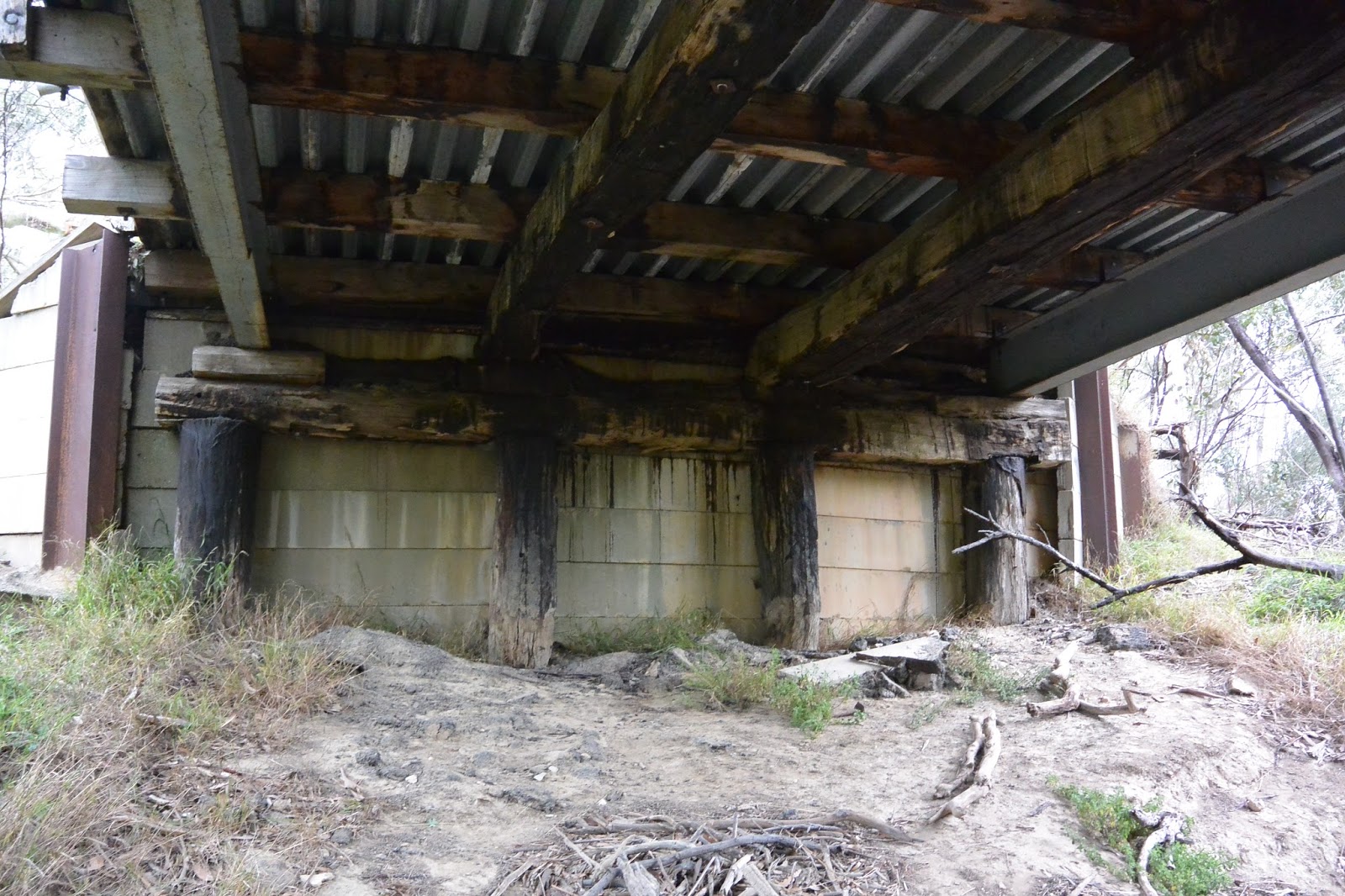
According to the description given by the Victorian Heritage Database, all of the piers, raker piles (angled beams supporting the piers) and some of the timber stringers (beams running the length of the bridge under the deck) are original. The stringers are showing obvious signs of decay. Other beams are newer replacements. To my untrained eye, the crossheads which sit across the top of the piles look newer and clearly the steel girders are also a later addition, as presumably are the crossbeams which they support. Likewise, the deck which is constructed of steel and concrete topped with bitumen would have replaced original timber. The abutments on either bank are reinforced with what appears to be relatively modern concrete slabs, held in place by steel girders driven into the bank and timber posts. Behind the slabs is more timber and concrete.
View underneath the bridge, looking north which shows the timber stringers
showing signs of decay and the original piles along with the newer steel beams
and deck
The problem however, is knowing which repairs occurred when and what is meant by "original". As far as I can tell, there has been a bridge on the site since 1857 when the Victorian Government Gazette gave contract details for a bridge to be built "over Sutherland's Creek on the road to Steiglitz" or 1858 when Roads and Bridges Office in Melbourne called for tenders for "the construction of a bridge over Sutherland's Creek. Approach to Steiglitz gold-field". In view of the latter comment, perhaps the latter date is most likely whilst the earlier date may refer to Hope's Bridge on the same road near Gheringhap.
 It was re-decked in 1871, again required repair in 1873 and then in 1874 was declared unsafe even for ordinary traffic, but little more is mentioned in the newspapers until the spring of 1880 when the Moorabool River and surrounding waterways experienced the largest flood in recorded history to that date.
Several bridges were described as having been washed away, including the Five Mile Bridge. Naturally, it was necessary to rebuild and it was common practice to cut costs by reusing any salvageable material, although whether this occurred here I do not know. With the rebuild underway, it was discovered in March, 1881 that the new structure was being built on soft, loamy, clay soil and in order to secure it, the bridge would have to be partially dismantled and then reconstructed using a significantly greater amount of timber than originally anticipated. The council considered the issue and called for tenders to either repair the existing structure or build a new one. Ultimately it was decided that the better option was to build a new bridge, however rather than replicate the existing 24 ft bridge, it was decided that the new structure would be 12 ft wide. The contract was eventually awarded to E Kennealey whose tender of £114 was accepted. In addition to completing the job, Kennealey also agreed to purchase some of the used timbers from the previous structure, however the following year, with payment still owing, the council abandoned the agreement.
Looking north along the deck of the old bridge. The new Ken Middleton Bridge
can be seen to the left of the picture
It is perhaps also worth noting that the shire engineer in charge of the project would have been Allan Robinson, a gentleman who had held this position since the earliest days of the Meredith Shire in 1864. During the 1880s however he faced allegations of laxity and carelessness in the completion of his duties. Finally at the insistence of the council, he tendered his resignation in September, 1888.
All this reconstruction however was ultimately for naught. In February, 1883 the creek flooded once more and the bridge was destroyed a second time. By September the shire was again calling for tenders for its reconstruction, indicating that a 66 ft wooden bridge over Sutherland's Creek was required. At this time, engineer Robinson had been given a leave of absence pending a council decision on his continued employment and it was left to the acting (and unqualified) engineer Mr J Murphy to deal with the matter. Murphy appealed to the engineer of neighbouring Leigh Shire - none other than CAC Wilson - to draw up plans for the bridge, however Wilson who was on leave at that time, sent one of his sons (possibly Frederick who later served as shire engineer to Meredith) to take the levels. The younger Wilson upon assessing the situation felt that it would be impossible to sink piles deep enough to stabilise the bridge, as the surrounding rock was too hard and too near the surface.
Section of an 1865 geological survey map showing the bridge site. The area is
composed of Post Pliocene clay, gravel and mud (green) and Silurian rock (grey)
with nearby patches of Miocene clay, gravel, shale and sand (brown). Original
image held by the State Library of Victoria
How this issue was resolved, I cannot discover, however it is certain that the bridge was reconstructed. On this occasion, the contract was awarded to F Lee and the works completed presumably without incident. There was a slight mishap however only a few years later in January, 1886 when a carter who was removing a house from Steiglitz township, clipped the handrail of the bridge causing unspecified damage to this and other parts of the bridge.
The bridge was almost destroyed yet again in 1898. This time however, the threat was fire, not flood. Fortunately, the coach service from Geelong to Steiglitz happened to be passing and the driver noticed smoke billowing from under the deck. He quickly raised the alarm at a neighbouring farm and the fire was extinguished before it could take proper hold of the timber decking. It was supposed that a camper had failed to properly put out a campfire underneath the bridge.
The southern end of the bridge showing the concrete abutments and scorched
timbers. The pile on the right has bitumen on its surface which appears to have
melted and dribbled down from above, but when I cannot tell
 There is little further mention of the bridge until 1902 when it was deemed unsafe for loads of over 1 ton. By 1915 things had reached crisis point and in March, it was decided to petition the government for the cost of a new bridge. The engineer at this time was CCP Wilson. I can find no further reference however to any attempt to secure funding for a new structure and in May, 1916 assessment by Bannockburn Shire Engineer ETM Garlick, revealed that four beams on the western (upriver) side of the bridge were completely rotten. Their replacement would provide a patch which would last no more than a year he claimed. Surprisingly then, only a few months later, the bridge was given a reprieve when it was declared that an expenditure of £91 would make it good for a further 12 years.
The bridge as it stands today showing original timbers in along with steel and
concrete additions
At this point, the online trail goes cold. I can find no further mention of what works were carried out on the structure or even whether a new bridge was built as deemed necessary in 1915. It seems likely that however old the original structure (various inquiries have proven fruitless), the steel beams would have been added as part of subsequent repairs as would the steel and concrete in the deck and abutments.
So far, the bridge has defied the odds, surviving fire and flood - most recently being threatened by a grass fire which moved through the area in January, 2014. The bridge continued in service until as recently as 2000/2001 when the Hansard papers for the November, 2000 sitting of the Victorian Legislative Council indicated that funds had been allocated for the construction of a new bridge at the site. An initial payment of $632,000 was estimated with a subsequent payment of $6,000 to follow in the 2000/2001 financial year.
Looking south over the new bridge, named for former Bannockburn Shire
engineer, the late Ken Middleton
Today the Five Mile Bridge stands almost unnoticed along side the newer, two-lane Ken Middleton Bridge which carries all traffic across the creek.


21 May, 2014

Branching out - GOLD! GOLD! GOLD!

There's gold in them thar hills! Well, in the Moorabool Valley to be precise - at Morrison's and Steiglitz on land which originally formed part of the squatting runs of Moranghurk, Durdidwarrah and Borhoneyghurk.
Gold was first discovered in the area in small quantities in 1851 but was not considered workable. In 1853, the squatter Andrew Love and George Morton found alluvial gold which resulted in a small flurry of activity, but it was not until late 1855 when William Hooley and Joseph Davis discovered the first of several gold reefs at Steiglitz on the banks of Sutherland's Creek near the bottom of the main street that the rush really started.
Timber bridge over Sutherland's Creek, Steiglitz
The table below gives a timeline of the development of gold mining along the Moorabool and it's tributaries - most notably Sutherland's Creek, Tea Tree Creek (which runs into the west bank of the Moorabool West Branch between Elaine and Morrison's) and Dolly's Creek (which also joins the west branch of the Moorabool from the same direction but further to the north).
Date
Place
Type of mining
1851
Morrison’s Station
-
1851
Dolly’s Creek
-
1855
Hooley & Davis discover reef at Sutherland’s Creek, Stieglitz
Quartz
1855
Sutherland’s Creek
Alluvial
1855
Yankee Gully
Alluvial
Late 1850s
Morrison’s Diggings
Alluvial
1857
Dolly’s Creek
Alluvial
1857
Tea Tree Creek
Alluvial
1862
Stony Rises
Alluvial
1863
Stony Rises
Quartz
1890s
More gold at Stieglitz
Quartz

This first rush in the area at Steiglitz involved alluvial mining, however reefs - the richest in the country - were also discovered and through the 1860s and 1870s deep lead mining of quartz veins became the norm. It was one of the first areas in the country where reef mining took place and in the very early days, the lack of quartz crushing facilities posed a problem so it was suggested that quartz be carted off site either to Geelong or back to England for crushing! This situation was soon rectified in 1856 when the first public crushing plant opened in Steiglitz and by 1862, fifteen quartz batteries were operating there.
Remains of a mullock heap at Steiglitz
As they were discovered and worked, the reefs were given names to differentiate them. The best known was perhaps New Chum, but others included Gibraltar, Tam-O-Shanter, Ironbark, New Years, Cooper's, Dreadnought, Yankee Smith,  Hanover, Boxing, Mayday, Sailors, Victoria, Clifton, Portuguese, Commissioners, Scotchman's, Birmingham, New Lode, Satchwell's, Garlick's, Durham and Italian.
The long term nature of reef mining and the requirement for heavy equipment meant that the settlement at Steiglitz was more permanent than many goldfields and by the late 1850s the town boasted four churches, five schools, four hotels and a police magistrate to maintain good order.
By 1859 Steiglitz boasted two bridges "paved with gold", specks of which could be seen in the quartz tailings from the worked out Italian Reef which were used as road base.
As the mining operations at Steiglitz began to shift from alluvial to reef mining, smaller claims were amalgamated and larger companies moved in, meaning miners were paid a wage rather than working their own claim. Some older reefs were also reworked as cheaper, more efficient methods of quartz crushing became available. By 1862, forty leads were being worked and 15 quartz crushers were operating. The majority  however were still involved in alluvial mining up and down Sutherland's Creek.
Sutherland's Creek just west of Steiglitz township
This was also the year in which the Geelong-Ballarat railway line opened, providing reliable transport to the goldfields which was connected from the station at Meredith by coach.  By the 1870s, there was also a public library, racecourse and the new brick courthouse which was built in 1875.
The courthouse at Steiglitz
By 1879 however, as the gold supply began to dwindle, the number of miners fell to about 100. The last crushing plant had closed a couple of years prior. People moved on and the population likewise dwindled.
As I discussed in one of my previous Woodbourne Creek posts, the 1860s saw changes in the law which opened up land for selection and closer settlement by small farmers. In the case of the Steiglitz area, many of these selectors had first tried their hand at mining but instead turned to the land to support their families. It was this pressure which saw the land east of the Moorabool River which had been part of the Moranghurk Estate, carved up into smaller properties when the squatting licence for the run was revoked in 1870.
Then, in the early 1890s, new gold deposits were discovered at Steiglitz and the miners began to return once again. The population sprang up to 2,000, trades and services returned, clubs and societies flourished to entertain the population. The boom was back.

Steiglitz township during the gold rush
However it was relatively short-lived and as yields dropped in the late 1890s, the population once again began to decline. People moved away, taking their business - and in many cases even their houses - with them.
Mining licences continued to be issued in small numbers over the years until 1941 when the last mine closed. From this time, public buildings were moved away and services relocated to other towns. Those who remained, looked to other industries to earn a living.
In 1951, the centenary celebrations marking the discovery of gold in the district saw the erection of a commemorative cairn. The central stone at the bottom was taken from the home of William Sharpe and those to the right and left from the original von Stieglitz home. They are topped by pieces of quartz from the abandoned mines.
Commemorative cairn at Steiglitz