Showing posts with label Bruce's Creek. Show all posts

05 July, 2013

BAIL UP!

Last year I posted about an escape from the Old Geelong Gaol (Jail Break!) by career criminals Christie Farrell and Josh Clarke in 1889. I also made passing reference to an incident much earlier in Christie's career: the robbery under arms of the Portland Mail.
This sensational hold up had everything. It featured a dashing but disguised bushranger with a criminal record and a flair for poetry, wielding handguns whilst shouting phrases such as "Bail Up!" and threatening to blow peoples' brains out. It also took place not too far from Bruce's Creek.
The following is my interpretation of events, taken mostly from the newspapers of the day (The Geelong Advertiser and Intelligencer and The Argus) and from Owen Suffolk's autobiography written during his final stint in an Australian jail in 1866.
The fateful event took place on the 19th May, 1851. The mail coach, its passengers and driver had stopped at the Leigh (now Shelford) to collect the mail and presumably to change horses. From there it followed its usual route towards Bruce's Creek (Bannockburn) and was travelling slowly, about a mile past the creek on the road to Geelong when Suffolk and his two accomplices struck.
The current (Pilloud's) Bridge across Bruce's Creek at Bannockburn

Whilst Farrell remained hidden, Suffolk and the third member of their little gang - Harry Dowling - intercepted the coach. Suffolk leapt to take the horses' heads, ordering the driver to "stand" and threatening to kill him if he did not. He also threatened to "shoot the first man who moved a finger" whilst Dowling ordered the passengers to raise their hands and get down from the coach. It was Suffolk who then bound their hands with their own kerchiefs (and in the case of the driver, with a belt taken from the driver of the Melbourne coach during an earlier hold up, to whom it was suggested he return it) before ordering them to re-embark and himself driving the coach about half a mile into the bush. The passengers were once again offloaded then tied to trees, at which point Dowling unhitched the horses and saddled one using a passenger's saddle and tack whilst Suffolk proceeded to rifle through the mailbags looking for cash, cheques and other valuables. That done, he also ordered the passengers to empty out their pockets.
Farrell it seems remained out of sight during the whole affair whilst Suffolk and Dowling were heavily disguised. By his own account, Suffolk was attired thus:
I had on three loosely fitting blue shirts or jumpers over a complete suit of clothes...my legs were encased in a pair of large gaiters which reached up to my hips. My head was placed inside the network of a rainbow comforter, which was secured against falling off by being fastened with a ribbon round my neck - one end of it hanging far down my back like a Chinaman's tail. A large sou'wester on my head, and a pair of light blucher boots, the soles of which were ornamented with as sort of scroll done with copper tacks, completed my costume.
This description which was not dissimilar to that later given by the witnesses in court is however somewhat at odds with a later illustration of the event by GD Bruny. Suffolk himself was somewhat bemused by media reports at the time which described him and "Farrell" variously as:
"a tall raw-boned Irishman [he was English] ill-becoming a suit of black" and "as two beardless boys of gentlemanly appearance, whom no one would have suspected of such crimes."
An account of the affair published some 48 years later by George E Boxall in his book "History of the Australian Bushranger" makes interesting reading when compared to Suffolk's own account and the reports from the media of the day.*

Depiction of Suffolk and "Farrell" waiting to bail up a coach, although from
the evidence of the witnesses and Suffolk's own description they were neither
mounted nor dressed in such fashion at the time of the hold up near Bruce's
Creek whilst Harry Dowling rather than Christie Farrell assisted Suffolk
to rob the coach.
All of this served to highlight Suffolk's own contention that witnesses could easily be misled by casual similarities and a few preconceived ideas. He argued that the bulkiness of his clothing and the concealment of both his and his accomplice's faces during the hold up meant that the witnesses could not have made an accurate identification of their assailants.

This fact later had serious consequences for Farrell, despite his remaining unseen throughout. In any case, the job was complete and the trio returned to Geelong, Farrell on foot and the other two riding the horses taken from the mail coach, which they then turned loose outside of town.
The following evening, in true dashing style, Suffolk decided to attend a performance at the Theatre Royal. However, having muddied his own boots en route, rather than return home to change, he elected to purchase another pair from an establishment he called "the famous Yellow Slipper". [My research shows that this was actually the Red Boot shoe shop in Moorabool Street, located opposite the Market Square.]
View of Geelong in 1861, taken from the corner of Kardinia and Malop Streets
looking south west. Malop Street crosses the bottom of the picture, Moorabool
Street runs to the left with the corner of the Market Square before it. The
Red Boot shoe shop, still in business some ten years later is the second store
from the left on Moorabool Street
At the store, he was surprised to be served by a former compatriot from Cockatoo Island. Knowing his history, this now reformed character was immediately suspicious of Suffolk's apparent affluence. Without letting on their previous acquaintance, the shopman (George Percy Simmons), along with his boss and the mailman from the hold up who recognised Suffolk's distinctive boots, informed the police and headed for the theatre. Suffolk saw them and quickly slipped out but Simmons also recognised Farrell as an associate of Suffolk and assuming he was the other assailant from the hold up, the three tried unsuccessfully to corner him before giving up and leaving it for the police.
The following day, Farrell and Dowling decided to distance themselves from the scene of the crime by taking the steamer to Melbourne. Suffolk advised against this as he claimed it would be watched by the authorities and chose to remain at the lodging house where they had been staying.
In the event, he was proven correct and Farrell, having been identified by Simmons, was arrested at the dock as he attempted to leave for Melbourne. Dowling, who of course was unknown to the storeman and happened to be carrying Farrell's share of the spoils remained undetected and made his escape.
Corio Bay, 1850 from Western Beach showing a steamer moored at the Steam
Packet Wharf
Suffolk's downfall came soon after as when questioned, Farrell gave the address at which he had been staying and so it was a simple matter to corner Suffolk at Guise's Lodging House (in James Street) the following morning and make the arrest.
Seeing the officers approaching through a window and hoping to hide evidence, Suffolk placed a watch stolen from the mailman under a pillow in Farrell's room after which he was duly arrested.
Until their case came to court a few days later, Suffolk and Farrell were lodged in what was then the Geelong Gaol, known to history as the South Geelong Gaol and located back from the banks of the Barwon at the corner of Balliang and Yarra Streets. Their first appearance to face the charges saw them brought before none other than police magistrate Captain Foster Fyans along with C N Thorne JP and Leiut Addis.
Then, on 21st June they faced a jury and the resident judge of the Geelong Circuit Court. In a noble attempt, in keeping with the theme of dashing gallantry, Suffolk quickly admitted his own guilt and made an eloquent argument in defence of Farrell's innocence . He admitted to hiding the watch and brought the young daughter of the house to the stand where she gave evidence that she had moved the handguns used by Suffolk to the drawer of Farrell's room as there was no available drawer in Suffolk's. When cross-questioning the storeman Simmons, Suffolk made a fair attempt to discredit the witness by quizzing him as to the length of their acquaintance and to their joint tenure on Cockatoo Island.
His efforts however, were all to no avail as the jury found both men guilty, sentencing them to ten years "on the roads", the first three to be served in irons. And so, despite having remained hidden and taken no active part in the holdup itself (assuming we can trust Suffolk's assertion that he was assisted by Dowling not Farrell), Farrell was convicted whilst Dowling escaped justice.
No doubt further confirming Suffolk's opinions as to witness veracity, one of the passengers indicated that he recognised "Farrell" by his voice.
A mail coach which I am guessing would have been similar to that travelling
the Portland to Geelong Route

*Below is an extract from George E Boxall's History of the Australian Bushrangers, 1899.

On June 23rd the mail coach was bailed up at Bruce's Creek, between Portland and Geelong. The coach, with three passengers on board, was going down hill to the crossing-place, when two men stepped from behind gum trees, presented their pistols, and cried "Bail up." The driver, William Freere, instead of complying, began to flog his horses, but before they could respond thir heads were seized by one of the bushrangers, while the other put his pistol to Freere's head; and threatened to blow his brains out. The coach was taken some distance off the road, and its occupants were tied to trees. The robbers went very leisurely through te letters, and when all that was of value had been abstracted one of the bushrangers took a saddle and bridle belonging to one of the passengers (Mr. Thomas Gibson) and set it aside with the remark, "Ah, this is just what I wanted." This bushranger was dressed "in a black suit of fashionable cut, and wore black kid gloves." He was afterwards identified as Owen Suffolk, while his companion was Christopher Farrell. Suffolk took one of the coach-horses, put the saddle and bridle on, and mounted. Farrell jumped on the other horse barebacked. The tied men begged hard to be let loose, offering to swear that they would not give information to the police, or move from the spot until their captors were away, but their supplications were only laughed at. The road was at that time but little frequented, and the next mail, which might possibly be the first vehicle to pass, would not come for a week. Moreover, they were out of sight of the road. The struggle to get free was therefore a struggle for life, and it was a severe one. Mr. Gibson was the first to get one hand loose. After this the rest was comparatively easy. In less than an hour they were all free, and they walked straight to the township at Bruce's Creek to tell the police. The robbers were caught in Geelong a day or two later. Suffolk was strolling along the beach near the wharf, and Farrell was found in a boardinghouse not far away. They were sentenced to ten years' penal servitude, the first three in irons.
It is easy to see how legends arise and misconceptions develop over the years. In his own version of events, Suffolk explicitly states that:
After securing all that seemed worth securing, I untied the mailman, and then, having released him from the tree, I fastened his hands behind him in a peculiar fashion, telling him that as soon as I knew we were out of sight he could set to work to undo one of the others, a task which I knew would take him some little time to perform with his own hands tied as they were. 
Hardly the life and death struggle described by Boxall, however it does not precisely tally with the version of events given by the mailman who made no mention of Suffolk telling him he could free himself once the robbers were out of sight.
In true Robin Hood style however, Suffolk also claimed to have returned via mail a sum of £5 to one of the passengers from whom he had taken two sovereigns. The man had pleaded poverty and a gravely ill wife when confronted by Suffolk who, on making later inquiries, discovered this to be the case. It probably would not do to dwell on how the extra £3 were obtained, but perhaps not surprisingly, according to Suffolk, this witness refused to testify at his subsequent trial.

04 July, 2013

Branching out - Bruce's Creek

All rivers have tributaries and the Barwon is no exception. Bruce's Creek is a tributary of the Barwon which rises to the north west of the township of Lethbridge and "flows" across the basalt plain, through Lethbridge and then Bannockburn and empties into the Barwon a little to the east of Murgheboluc. (NB Whilst it does have areas which contain water, it does not have a continuous flow.)
This little creek like much of the district through which it runs has seen quite a bit of history. Prior to European settlement, the area through which Bruce's Creek runs formed part of the land belonging to the Wathaurong, who used the stream bed as pathway to guide them to the Barwon.

Bruce's Creek where it crosses the Hamilton Highway and "flows" west before
joining the Barwon River near Murgheboluc
With the arrival of European settlers, the surrounding land was opened up to grazing and then farming. The creek derives its name from the settler James Bruce who occupied land in the area from 1840 and claimed descent from the famous Robert The Bruce of Scotland who defeated the English in the Battle of Bannockburn. In a nod to the famous battle, this name was eventually given to the township which was established on the creek's banks.
Bruce was the second European to occupy the land, the first having been George Russell who held the land in the name of the Clyde company as part of his Golf Hill Station, but resided some distance away at Shelford (then known as Leigh) on the Leigh River.
Prior to the town's development the area was known either as Leigh Road (the name given to the railway station which opened there on the Geelong-Ballarat railway line in 1863) or simply as Bruce's Creek. In these earliest days, there was no bridge, just a collection of the readily-available basalt rocks piled across the creek to form a fording point. The ford still exists and is listed on the Victorian Heritage Database, but with little additional information, I am unsure if this was a public vehicle crossing point however, early maps do not seem to indicate that it was ever part of the route of the Lower Leigh Road of the 1850s between Bannockburn and the Leigh.
Historic crossing on Bruce's Creek near Bannockburn

Bruce's Creek ford

The ford and track leading over the hill towards Bannockburn
On the contrary, an 1855 surveyor's map of the "township and suburbs of Bannockburn" shows a bridge at the point where today's Pilloud's Bridge stands, located about 2km downstream from the ford. I am unsure of the age of the modern bridge, but it appears to be a newer structure supported by older bluestone piers.
Pilloud's Bridge across Bruce's Creek, Bannockburn
The other township to spring up on the banks of the creek was Lethbridge, originally known as Muddy Water Holes for a chain of ponds which ran along Bruce's Creek at that point. Gazetted in 1854, the town originally centred around the Ballarat Road (Midland Highway) and catered to the traffic passing to the newly discovered goldfields of Ballarat. From 1858 when the railway came, Lethbridge thrived as local bluestone was quarried to build the line, however as in Bannockburn, the centre of business eventually drifted away from the highway to the railway line with businesses either closing or relocating to survive. This left only the Lethbridge Primary School and the Catholic Church on the road to Ballarat, however in an ironic reversal, the school and church have now both closed, but a significant increase in housing has occurred along the highway.
As with much of the country, European settlement caused significant change to the immediate environment of Bruce's Creek. The area through which the creek runs is part of the Victorian volcanic plain region, categorised today as lying within the Leigh Landscape Zone. This particular area is flat and rocky and before European arrival, would have been a lightly-wooded, grassy plain. Since then, significant clearing of the ever-present rocks and trees to enable grazing and farming, has given much of the landscape surrounding the creek quite a barren look and in many places there are few or no trees along the creek at all.
The other significant factor influencing the appearance of the creek was the construction from 1858 of the Geelong-Ballarat railway line. In order to provide access for vehicles carrying bluestone from the quarry at Lethbridge to the railway works, a small bridge - also of bluestone - was built across Bruce's Creek on Russell Street in the township.
Bridge over Bruce's Creek, Russell St, Lethbridge
The Victorian Railways created a reservoir along the course of the creek some few hundred metres from the Lethbridge station along with a 90,000 litre tank and a pump which supplied water for the steam trains as they made the long uphill haul from Geelong to Ballarat.
In the 1970s when diesel had replaced steam, the council purchased the reservoir which was developed into a lake and picnic area and is now home to a variety of birdlife.
As mentioned in an earlier post - Walking the line - the railways built a second bridge across Bruce's Creek, between Lethbridge and Bannockburn, known to locals as the Lower Camp Bridge after the workers who camped at that point as they worked on the line.

The "Lower Camp Bridge"
Today, in addition to the bluestone bridges built by the railway, the ford at Bannockburn and no doubt a number of informal crossings on private property (I know of at least one) there are modern bridges at Bannockburn (Pilloud's Bridge) and the unnamed road bridge on the Hamilton Highway near Murgheboluc.
Looking to the future, the Golden Plains Shire and its landholders are acting to improve the health of this little waterway, preserving and enhancing remnant vegetation and developing plans for the future management and use of the creek and its surrounds.


04 June, 2013

Walking the line

Following on from my previous post Anticipating the Octopus Act, I thought it might be interesting to look at the route finally chosen for the Geelong-Ballarat railway line and to use some of those photos I've been saving for just such a post. So here it is:
After the opening of the rail link between Melbourne and the growing township of Geelong (population 23,352) in 1857, tenders were taken and in 1858 construction began on the Geelong-Ballarat railway line. The chosen route branching off the Melbourne-Geelong line at North Geelong did not cross the Barwon River as at least one proponent had suggested, instead, it crossed the Moorabool River by means of the  the Moorabool Viaduct  located about 1.5km west of the Geelong-Ballan Road.

The Moorabool Viaduct 1863
The line was officially opened on 10th April, 1862, following the route we know today. It remained the only rail link from Melbourne to Ballarat until 1889 when a direct line between those two cities was opened.
The 86km of line from Geelong to Ballarat was built to the highest engineering standards of the day and in addition to the viaduct, included a number of bridges crossing roads and creeks.

Rail bridge near Moorabool station
Not surprisingly given that the line passes across one of the world's largest volcanic plains, the predominant building material was bluestone, examples of which can still be seen right along the line.

Double-arched bluestone bridge carrying the Geelong-Ballarat rail line across
Cowies Creek and Bluestone Bridge Road at Lovely Banks
Stone for the construction was quarried at Lethbridge, which township the line passed en route. During construction of the Lethbridge section of the line, workers lived in tents at two camps along the line. One was located a few hundred metres north of Lethbridge station. The other, about 3km south and a little east of Lethbridge, was situated on the banks of Bruce's Creek (a tributary of the Barwon River) just to the south of a bluestone rail bridge which crossed the creek on the property owned by my grandfather (Jack Stevenson) about a century later.

Lower Camp Bridge, outside Lethbridge
Today I took a walk up the line from Lethbridge Station and snapped some photos.
The bridge was known to locals as Lower Camp Bridge, presumably after the men who built it. Rivalry between the two camps was strong, both on the sporting field of a Sunday afternoon and in their bridge-building prowess. Attention to detail can be seen in the finish of the stonework on the bridges near Lethbridge. Perhaps I'm biased, but the detail of the Lower Camp Bridge does seem somewhat greater.

Road bridge on Quarry Road, Lethbridge


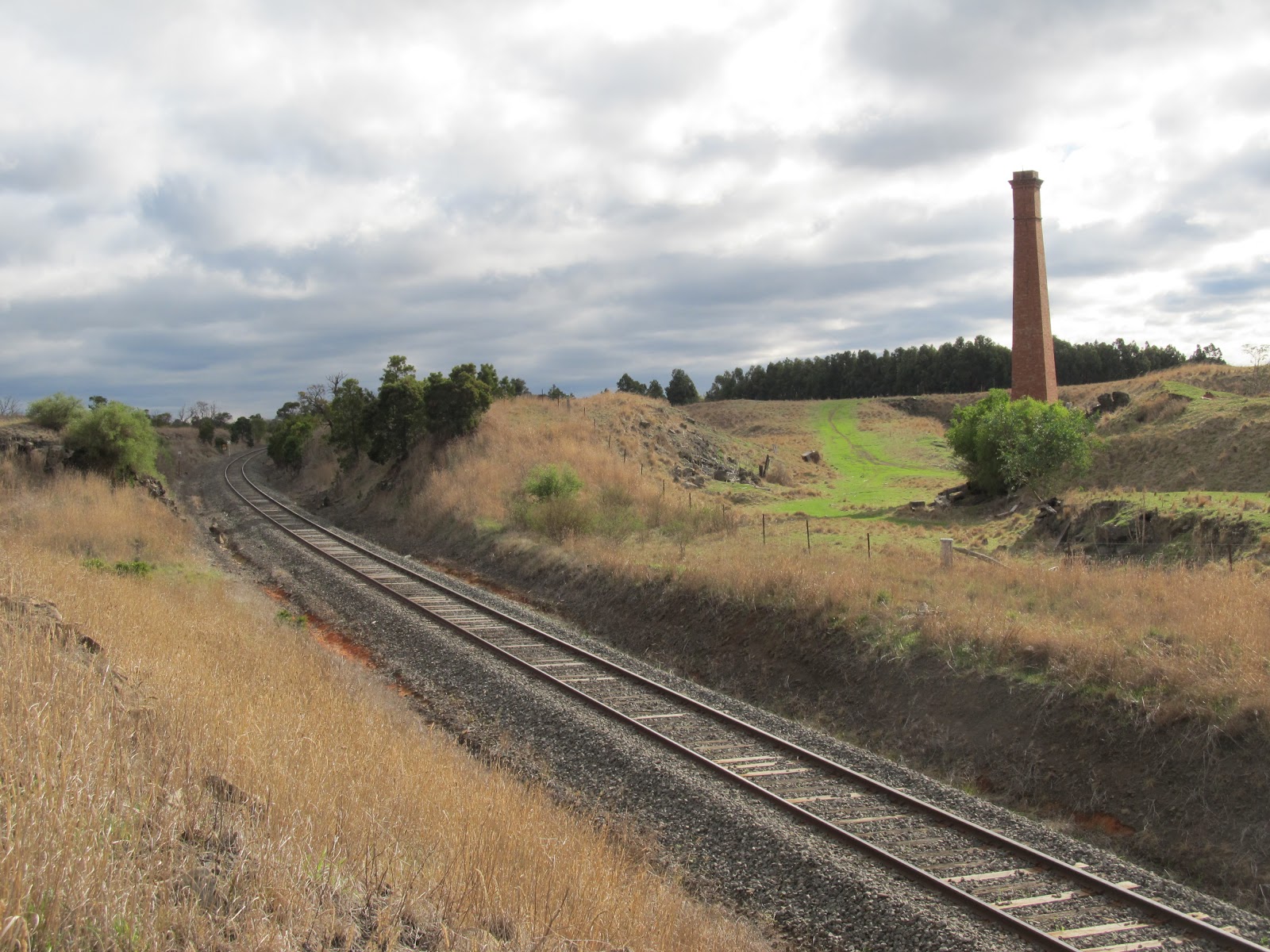
Remaining chimney at the quarry from which stone was cut for the
Geelong-Ballarat railway line (later Nash's Quarry)
Rail bridge over O'Connor Road, Lethbridge
By comparison, the bridge across Bruce's Creek on Russell Street in town is a much simpler construction. Whilst not part of the railway infrastructure, it was built by the railway to allow access to their works.
Bridge over Bruce's Creek on Russell Street, Lethbridge
Initial stations - also of bluestone - were erected along the line at Moorabool, Lethbridge, Meredith, Lal Lal and Yendon (Buninyong). Later stations were added to the line at Geringhap, Bannockburn, Elaine, Navigators and Warrenheip. The stations at Moorabool, Bannockburn, Lethbridge, Meredith and Lal Lal remain standing today:
Moorabool Station April, 2012
Bannockburn Station April, 2012

Lethbridge Station April, 2012


Meredith Station April, 2012
1The Geelong-Ballarat railway celebrated its 150th anniversary in April, 2012 with an open day and special vintage rail service. Freight traffic for Mildura continues to travel via the Geelong-Ballarat line however, passenger services were suspended in 1978. A recently concluded study looked into the feasibility of re-introducing a rail passenger service between Geelong and Ballarat, extending to Bendigo via Maryborough and Castlemaine. It was estimated that such a project would cost almost $1 billion to implement with ongoing running costs of $17 million per year and was unlikely to receive funding however, some within political circles are not quite willing to write the subject off just yet, pointing out that figures for the Geelong-Ballarat section of the line alone may be more economically viable...