Showing posts with label Rowing. Show all posts

31 January, 2016

A very busy Barwon

This week-end saw a number of sporting events take place on or by the Barwon, so I thought I'd take a short break from what has been a very long trek from the banks of the Barwon in Geelong to the upper reaches of the Yarrowee River and the goldfields of the 1850s.
I already knew it was going to be hectic and I planned to be there. As always on Saturday morning come rain, hail or shine, the Balyang Sanctuary Parkrunners were out and about early. Also on the move were a host of rowers all in attendance for the Barwon Regatta, held across the week-end.
The Barwon Regatta, 2016
After negotiating my way through the throng, I headed upriver on the bike, past King Lloyd Reserve where Murgheboluc Cricket Club were taking on Grovedale.
Cricket at King Lloyd Reserve
My intended destination on this occasion was the Queen's Park Bridge where I picked my spot amongst the spectators and waited for the cyclists riding the elite women's section of the Cadel Evans Great Ocean Road Race. I made it with time to spare and chatted to one of the locals as we waited for the riders to come charging down Scenic Rd and over the Queen's Park Bridge. As usual with cycling races, as fast as they arrived, the riders were gone.
Elite women's road race
Job done, I retraced my steps, snapping a few more shots along the way.
In addition to the formal, competitive sports on offer, there was also an array of people undertaking a variety of leisure activities which also came under the heading of sport. As the cyclists headed over the Queen's Park Bridge, a pair of kayakers headed under it:
Kayaking on the Barwon
A little further downriver, a dragon boat crew were practising...
The Geelong Juggernauts on the river
...as a family jogged along the bank.
Nice afternoon for a run
Meanwhile back at Landy Field, Geelong Athletics were also doing their thing:

Athletics meet at Landy Field
It often occurs to me to be impressed by the number of sporting activities which take place in, on or beside the Barwon and today, in addition to the sports I was able to photograph, there were of course, recreational cyclists and walkers and golf was being played both up and downstream of where I was.
With the river closed for the rowing, the water skiers were absent as were the winter sports of football, netball and hockey whilst fishing and swimming are more likely to happen on other parts of the river - and those are just the sports which come to mind.
And that was just Saturday! Sunday, I once again spent along the banks of the river, this time, riding from point to point, watching the men's version of the Cadel Evans Great Ocean Road Race:
Simon Gerrans and co headed for Barwon Heads via the Breakwater Bridge
Onto Barrabool Road for the last time

All in all, the Barwon can be a very busy river.


04 April, 2013

Good in any emergency!

The Barwon River is not generally associated with great voyages of exploration. It is after all, only a relatively short river, flowing through a predominantly inhabited landscape in a temperate climate; not exactly the kind of place you'd expect to find an Antarctic explorer, right?
Well, perhaps not recently, but in January, 1907 the future Antarctic explorer Bertram Armytage undertook a journey which saw him scull a kayak from Geelong to Barwon Heads as part of a 10 day journey around Port Philip Bay.
Armytage was a local boy, born in 1869 into the prosperous Armytage family at Wooloomanata Station near Anakie. His father Frederick William Armytage was the sixth son of George Armytage, the progenitor of one of Victoria's most successful nineteenth century dynasties.
As a young teenager, Bertram spent three years being educated at Geelong Grammar School, before transferring to Melbourne Grammar in 1885.  In what was probably his first year at the school - by then situated in Maud Street, Geelong - he would no doubt have come in contact with that champion of the Barwon and rowing enthusiast James Lister Cuthbertson about whom I have blogged previously. Perhaps it was he who first encouraged the young Armytage to develop his considerable skill with the oar as he went on to row for Jesus College, Cambridge where he "won his oars", by which I gather it was meant that he rowed in the head crew for his college.

Bertram Armytage in 1894 from the Como Collection,
National Trust of Victoria. Como in Toorak was another
Armytage property
Upon his return to Australia he spent time at Wooloomanata and then at another family property in Queensland before joining the military and serving in the Boer War as an Imperial Officer.
After the war he seems to have lived the life of a socialite in Melbourne and London, satisfying his need for action and adventure by participating in what today would be seen as endurance sports. It was in preparation for one such deer-stalking trip in the New Zealand Alps that he decided to undertake a circumnavigation of Port Philip Bay - by kayak.
The craft he had purpose-designed for the task was an early kayak based on the model of the Inuit people of the Arctic who used timber and sealskin to construct their craft. Here perhaps the similarities ended as Armytage's custom-designed kayak had curved ends described as being like an Italian Gondola and was weighted with lead, giving it self-righting properties. It had a thin timber skin and he adapted the hollow areas normally used for buoyancy, to carry equipment then, in a nod to his rowing days, he rigged a sliding seat and sculls to the craft which produced significantly greater speed than the usual paddle used with a kayak.
So, on the morning of 15th January 1907, sufficiently stocked with supplies of bananas and chocolate which he had learnt from his deer-stalking exploits were the best energy foods available, he took to the water at Point Cook and headed towards Geelong. By lunchtime he had made it as far as Little River where he stopped for a lunch of bananas before ploughing on to Point Wilson where he spent the night.

Corio Bay with the You Yangs in the distance
The next day saw him enter the inner harbour of Corio Bay at which point he decided to alter his plan to follow the line the bay, deciding instead to have his kayak transported to the banks of the Barwon from whence on the following day, he sculled his way to Barwon Heads, arriving in the early evening. He had timed his run to co-incide with high tide to ease his passage through the very shallow Lake Connewarre - I can relate to that problem! - and was apparently treated to the sight of large flocks of water birds blissfully unaware of the impending approach of the hunting season.
Lake Connewarre
No fool, he then spent a day or two running some tests on the resilience of his craft before attempting the highly risky passage across The Rip.
Having satisfied himself that with the right weather conditions and a certain amount of luck, the crossing was possible, on 21st January he set out once again, taking the very sensible precaution of leaving his luggage with "Messrs Stephens" who then guided him across The Rip in their fishing boat. Just why Armytage chose to alter his route to include the Barwon and a Rip crossing from Barwon Heads is not stated. This route was shorter than staying inside the bay and rowing around the end of the Bellarine Peninsula, but I am guessing that for the sake of an extra 20-30km, it would have been far safer to cross The Rip insde the Heads, however the safe option did not usually appeal to Armytage.
Newspaper reports describing the trip confirm that Armytage chose the more dangerous route, presumably due to the open water which also had to be crossed outside the bay. In the end, the attempt was a success and crossing The Rip itself proved less troublesome than negotiating the seas breaking over reefs off Barwon Heads.
Looking towards The Rip from Barwon Heads Bluff and the stretch of
water traversed by Armytage. The opening between Point Nepean (right) and
Point Lonsdale (left) is approximately 3.5km wide
By 4pm he had reached Sorrento, his intended destination for the day. After spending the following day there, he once again took to the water, facing difficult conditions as he made his way around the coastline. He encountered rough seas off Mt Martha, being forced to bail water out of his kayak and the stretch from Frankston to Mordialloc saw him facing a headwind and more rough water.
Finally however, on 25th January, he completed the final stage of his journey which appears to have taken him from Mordialloc, past St Kilda and then - through a thunderstorm - up the Yarra to Edward's Boathouse at Princes Bridge. Why he did not return to Point Cook which is mentioned as his starting point is not clear. Is it possible that he in fact departed the previous day from Edward's Boathouse, overnighting at Point Cook before The Argus (2nd March, 1907) takes up the tale?
Part of Armytage's intention in undertaking his journey around the bay was to improve his fitness for an upcoming deer-hunting trek in New Zealand which was to take place later in the year. On his way to New Zealand however, he got wind of an upcoming Antarctic expedition to be led by Sir Ernest Shackleton. Armytage quickly determined that he would join the party and with an introductory letter in hand, made himself known to Shackleton.

Bertram Armytage in the Antarctic
After some close questioning, Armytage was invited to join the party and given the role of assisting the geologists (including one by the name of Douglas Mawson) and of caring for the several Manchurian ponies  which were to be used by the explorers in their attempt to reach the South Pole.  The Nimrod Expedition as it was known, departed from New Zealand on 1st January, 1908. A base camp was set up at Cape Royds and "Shackleton's Hut" which still stands today, was erected. Whilst Armytage did undertake some treks during the expedition (leading at least one to the north), he was not amongst those who made the attempt to reach the South Pole. The group was unsuccessful in its attempt, however Shackleton and his companions did reach a point further south than any other explorer at that time.
 In an inverview given after the party's return, Shackleton himself described Armytage as "loyal, serious and good in any emergency".
Shackleton's Hut, Cape Royds, taken from Wikipedia
The geographic South Pole was finally reached on 14th December, 1911 by a party lead by the Norwegian Roald Amundsen. Armytage however, did not live to learn of the party's achievement.
After returning from the failed Nimrod Expedition and being feted in both London and Melbourne, he applied for a position with the War Office in London but was unsuccessful. Upon returning to Melbourne, it is believed that his thwarted ambitions may have lead to his suicide on 12th March, 1910. At the time of his death, his wife (related by marriage to the well-known Chirnside family) and young daughter were in London.
In 1920 his mother established the "Bertram Armytage Prize" with a grant of £500 in his memory. The prize is awarded annually in the field of medical science at Melbourne University.

NB: details of Armytage's journey around the bay were taken from an article published in The Argus, 2nd March, 1907.


03 November, 2012

"The school of the Barwon"

In my previous post, I looked at the early days of Geelong Grammar and at the old school building in Maud Street, Geelong. Aside from its relative proximity to the Barwon and the probable use of bluestone from quarries along the river in its construction, the school has close historical ties to the river which date back formally to 1870 when boys from the school took up rowing. In these early years, they made use of the Barwon Rowing Club's boats, honing their skills in preparation for taking on the best that the Melbourne public Schools had to offer. In 1873 and realising the talent amongst the school boy rowers, Barwon held scratch four races in which both Grammar and Geelong College took part with Grammar winning the event which did not go unremarked in the newspapers of the day.
The current crop: a Grammar crew on the Barwon January, 2012
In 1874 Grammar formally established its own rowing club and bought its first boat. The following year saw the arrival at the school of James Lister Cuthbertson - a master who would come to define rowing at Geelong Grammar and significantly influence the Victorian School Boys Head of the River - the longest-running school boy rowing event in the world. The Head of the River dates back to 1868 and was first held, not on the Barwon, but on the Yarra River between Melbourne Grammar and Scotch College in Melbourne.
Geelong first competed against the Melbourne schools in 1874 but did not contest the Head of the River until the following year. It was another three years before they took home the title, winning for the first time in 1878. These early races were all held on the Yarra River in Melbourne, however in 1879, following Grammar's win the previous year, the race was held for the first time on the Barwon River in Geelong. From this time the race moved back and forth between the Barwon and the Yarra until 1948 when it moved permanently to Geelong. This continued until 2001 when the race moved to the Olympic standard course at Nagambie.
Until 1900, the Head of the River was contested by coxed fours in boats of varying styles (for details see Wikipedia), however after this date the race was contested by crews of eight. This would have been well received by Cuthbertson who spent much of his 20 year teaching career at Grammar, lobbying the collective headmasters of the public schools for just such a move.
Grammar crew on a very rainy Barwon. Training isn't always sunshine and picnics
Hired by the school in 1875 "Cuthy" was born in Glasgow, Scotland in 1851. He studied for the Indian Civil Service at Oxford but had a change of career plan when he failed one of the required exams. Possibly encouraged by the fact that his father managed the Bank of South Australia in Adelaide for a time, he came to Australia where he took up the position of master of classics at Geelong Grammar. He returned to England in 1882 to complete his degree at Oxford which he did in 1885 and then returned to resume his position at Grammar.
In addition to his academic duties, Cuthbertson enjoyed the outdoors and was a keen bushwalker, often spending his weekends taking groups of boys hiking at Mt Moriac, the You Yangs or the place he spent the most time - the Barwon.
During rowing season he would often head out on a Friday with a crew of four or eight boys and they would row downstream, sometimes staying over night at one of several popular camping spots such as The Willows (which as far as I can tell was on the river in the vicinity of the St Albans Homestead), Campbell's Point (extends prominently into Lake Connewarre from the north bank), Cormorant (can't pin this one down, but would guess downstream of Campbell's Point) or at Barwon Heads. Once at the Heads, Saturday would be spent lazing on the beach or hiking in the surrounding area before the long pull back upstream to Geelong. It was perhaps these extended training sessions along with Cuthbertson's passionate interest in rowing and in his students which saw Grammar become the strongest school in the APS between the years of 1878 and 1895, winning the Head of the River no less than 12 times in this 18 year period including a run of six consecutive wins between 1885 and 1890.
Looking towards Campbell's Point (right) from Ash Road, Leopold
Following the death in 1895 of his much respected colleague and headmaster, John Bracebridge Wilson, Cuthbertson acted as principal for the remainder of the year. A new appointment was made early in 1896 but it soon became clear that he would not enjoy the same relationship with the new principal that he had with Bracebridge Wilson and he agreed to leave, however he maintained close ties with the school until his death in 1910.
To the present date, Geelong Grammar has won the Head of the River no less than 33 times, a record surpassed only by Scotch College who have held the title on 40 occasions and are the current champions.
James Lister Cuthbertson is remembered today by the school primarily in the senior boys boarding house at the Corio campus which bears his name and in the Cuthbertson Health and Wellbeing Centre, but he was also, a poet of note whose published works are contained in the volume "Barwon Ballads and School Verses." Some of those verses will be the subject of my next post.

01 November, 2012

The old Light Blue

The next couple of posts I intend to write are of interest to me for several different reasons, not least of which is that they closely involve my alma mater - Geelong Grammar. Not however, the Grammar of today, spread far and wide across Geelong and the state of Victoria, but rather Grammar in its earliest days as a school.
Initially catering to only 14 boys, the Geelong Church of England Grammar School was established in 1855 in Villamanta Street, Geelong West with the support of the then Bishop of Melbourne, The Rt Rev. C. Perry. The following year it moved to Knowle House in Skene Street, Newtown before relocating once again in 1858 to its purpose-built campus in central Geelong.  The new school and its grounds were located on the block of land bounded by McKillop Street to the north, Maud Street to the south and Moorabool and Yarra Streets to the west and east respectively - perfectly situated on a ridge line overlooking Corio Bay to the north and the Barwon River to the south. The town centre was nearby with both the bay and the river providing easy access to a variety of sporting and recreational activities - an aspect of education which the school has always considered an important addition to academic pursuits.

Geelong Grammar School, 1862 showing the front entrance facing
Moorabool Street. Image held by the Victorian State Library
And they did not take long to take advantage of the river's proximity when in 1870 boys began rowing with the Barwon Rowing Club. By 1874 the school had established its own rowing club on the banks of the Barwon and before long were competing with the best.
The school building itself was built by the architect firm of Backhouse and Reynolds in 1857 whose design won a competition for the contract. The brief for the building was that it must cater for 525 pupils and include a residence for the headmaster.  Their building was a quadrangular construction in the Tudor Gothic revival style with the master's quarters contained in the south wing and amenities located in the east. A single story wing faced north with the main entrance off Moorabool Street.
The building is repeatedly described as bluestone and concrete-rendered, however the picture above and another from about 1914 appear to show a bluestone finish with sandstone dressings on the north wing, rather than a rendered finish. By contrast the sections of the building which remain today (the south and east wings) are definitely concrete-rendered. Whether only part of the building was rendered or this was added later, I don't know.
Also unknown (by me) are the origins of the building materials used to construct the school. This is somewhat of a contrast to many of the historic buildings around Geelong and along the Barwon, however given the date of construction and the sourcing of materials for other buildings from this period, I would hazard a guess that the bluestone was quite quarried somewhere along the Barwon.
This image of the school taken some time after 1914 also appears to show
bluestone with dressed sandstone on the north wing. Image held by the
Victorian State Library
 Like much of the original building, the first occupants are long gone. The first headmaster was the Rev. George Oakley Vance who resigned in 1860 when the school closed as a result of funding issues. It had only been in its new premises for two years, however one of the masters - John Bracebridge Wilson - who had joined the staff in 1858 managed to keep the student body together, teaching 40 students in rented premises until, in 1863 with 58 day students, 2 boarders and Bracebridge Wilson as its principal, the school reopened at its McKillop Street campus as the grammar school. Presumably to avoid a repeat of earlier problems, the new-look Grammar saw a number of changes. A restructuring took place which also included the drawing up of a new constitution. This change in direction was driven by a new group of trustees including prominent Western District names such as Chirnside, Armytage and Manifold as well as that noted Geelong citizen and owner of Sladen House - Sir Charles Sladen.
Over the latter half of the 19th century, the school continued to build its reputation and by 1911 had outgrown the Moorabool Street campus. The decision was taken to sell both this campus and land which had previously been earmarked as a potential school site in Belmont and move to 400 acres of land on the banks of Limeburner's Bay in Corio.
The move took place in 1914 and the old building and grounds were sold to the Geelong City Council who had planned to use the building as a town hall - a plan which never came to fruition. Over the following years, the grounds were gradually subdivided and sold and in 1916 the west wing which included the main entrance was demolished. The north wing and quadrangle area were put to use as a factory whilst the remaining south and east wings became the private hotel called Dysart.

The remaining south wing of the school (facing Maud Street) in 1930 known as
the hotel Dysart. Image held by the Victorian State Library

In 1954 the building was sold once again, this time returning to its educational roots, when it became the Reformed Theological College, in which capacity it still operated in 1986 when I sat my HSC German oral exam in the building.
According to the Victorian Heritage Database, the north wing was demolished in about 1960, leaving only the east and south wings which the Theological College occupied until 1999 when they relocated to another former Geelong Grammar campus at Highton.
This remaining section of the building comprises 47 rooms including three bathrooms, a large kitchen as well as living and dining rooms. After the departure of the Theological College, it was sold once again, passing through the hands of a number of private owners before most recently being put on the market in June, 2011 by its owner of ten years, Norm Lyons - a local businessman.
The former Geelong Grammar in October, 2012
The sale of the property finally took place in May, 2012 and settlement is due to occur some time within the next few weeks (November, 2012). The buyer is an undisclosed local investor who, the agent stated, plans to renovate the property and continue its use as a private residence. A subsequent article in the Geelong Independent of 7th September suggested the building will be developed into student apartments. The sale price was undisclosed but is believed to be somewhere in the vicinity of $2.45 million.
Going once! Going twice! Going three times! Sold!

05 August, 2012

A golden opportunity

With all the current hype over the London Olympics, naturally I went looking to see if the Barwon had any Olympic credentials. It didn't take long before I was onto something.
Most obvious were the sporting facilities named for our Olympic champions - the Landy Field Recreation Reserve in South Geelong named for Olympic track champion Peter Landy:
John Landy Athletics Field, with the Barwon in the middle distance
and the newly installed Troop Loop, opened by its namesake Lee Troop - the 3 time Olympic marathon runner - earlier last month.
Newly installed Troop Loop Signage
But Geelong has never hosted the Olympic Games and therefore the Barwon would not have seen any Olympic action - right? Well, no it hasn't. However, it very nearly did. In the lead up to the 1956 Olympics in Melbourne, there was no doubt a considerable amount of to-ing and fro-ing about where various Olympic events were to be held and one of the sports whose location was up for grabs was rowing.
History tells us of course, that the rowing events of the 1956 Olympic Games were held on Lake Wendouree in Ballarat, however in 1951 when planning for the games was underway, this was by no means a foregone conclusion. On 29th March, the Argus carried an article titled "Rowing Row Likely" in which it stated:
Geelong Authorities will protest strongly to the Australian Olympic Federation if Lake Wendouree, Ballarat, is chosen as the Olympic rowing course instead of the Barwon River, Geelong.
A Geelong-based committee, set up to further the Barwon's claim as an Olympic venue, pushed the point that the Barwon Trust had plans to upgrade the rowing section of the river to create an Olympic-standard 2000m course which they felt would be far superior to Lake Wendouree.
In the event, Lake Wendouree was chosen and no doubt the Geelong committee were left wondering what might have been.
Crews on the Barwon, January, 2012
Fast-forward once again to the present day and whilst any dreams of the Barwon becoming an Olympic venue are well in the past, our river has not been without its fair share of Olympic rowers. Of the present crop, women's eight rower Phoebe Stanley is a local girl who has no doubt spent many hours pulling her way through the waters of the Barwon. A former Geelong College student, Phoebe won two Head of the River titles with fellow crew members during her time at the school and it was in part due to the continued support of her old school that she and her crew had the opportunity to row in London where they finished sixth in the final.
The easily recognised orange caps of the Corio Bay Rowing Club's
quad sculls
Another local competitor who incidentally is also an Old Collegian, is men's coxless four rower Josh Dunkley-Smith. Dunkley-Smith and his crew - the current "Oarsome Foursome" - rowed their way to a silver medal on the eighth day of the London games. And like Stanley he has also spent a significant amount of time training and competing along the rowing mile of the Barwon.

28 January, 2012

Still seeing green

Time for another quick algae update. The local media has been scattered with articles over the past several days and as of Wednesday morning, the Barwon has been closed upstream of Moorabool Street to below Baum's Weir according to information from the Corangamite Catchment Management Authority who are responsible for monitoring the river's health.
Lake Connewarre is also closed but the river at Barwon Heads is not, despite toxin levels being high there too. Certainly there was no visible indication of the algae at Barwon Heads a week ago, however the problem with the toxins produced by blue green algae is that, unlike the algae itself, they are colourless and odourless, meaning that it is not possible to gauge river health with the naked eye. In addition, the toxins can hang around longer than the algae, meaning that water quality can be unsafe even once the bloom is gone, as various authorities have been at pains to point out.
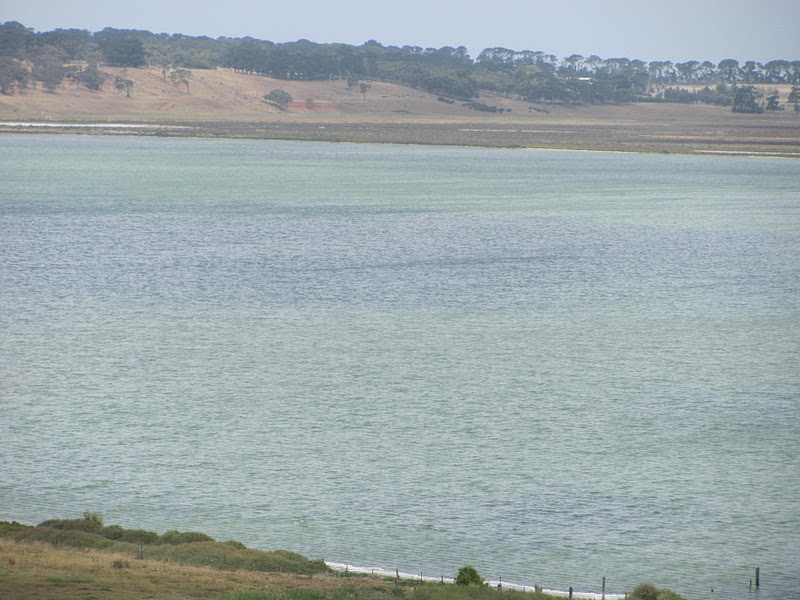
On Wednesday I thought I'd have a look at Lake Connewarre and see if the bloom was as spectacular there as the one upriver, however I was to be disappointed on this occasion. Water levels were clearly lower than over winter and I could certainly see a distinctly green tinge to areas of the lake, but nothing like the luminescent shades at Queen's Park.
Blue green algae at Lake Connewarre
As of Friday morning, the river was still closed to water activities - although for some reason this doesn't seem to include rowers as it seemed that every school for a good many miles around had at least one crew on the water. Maybe they are immune to such toxins or perhaps too tough to care!
 In my own quest to maintain some grit, I went for a run to Queen's Park and back and snuck a quick glance at the river on my way past. Certainly it was still more green than brown in many parts, but there didn't seem to be quite the same crust of algae covering the surface of the water near the lilies as there was earlier in the week.
Women's coxed fours
Nor it seems is a bit of green muck a hindrance to a two day rowing carnival on the river. The competitors, officials and supporters assembled bright and early Saturday morning and with appropriate warnings about the action to be taken in case of contact with river water proceedings got under way as they have done on the Barwon for over 140 years. A previous post here has looked at the history of rowing on the Barwon.
Geelong Grammar eight

Corio Bay Rowing Club double scull
And so the events continued seemingly with no ill effects either for the rowers or the family of ducks paddling in the shallows. Meanwhile, we sat on the bank on a sunny afternoon and took in the view, high and dry and safe from the algae.
By contrast, the weather forecast for the next couple of days is not quite so benign and there may well be some rain to flush the system clean. Help may also be at hand in the form of a serendipitous release of 40 million litres of water into the Moorabool from the reserves at Lal Lal. Whilst it won't be much help upstream of Fyansford, it may help water quality downstream through Geelong.
This ten day release which began on the 23rd January is one of three for the summer designed to deliver "environmental" flows to the river, enhancing the benefits already derived from the good rainfall over the last year. It has also been timed to coincide with the release of 27 million litres of water per day into the river for use by Geelong over the summer months.
So hopefully with a little time and a bit more water, all should soon return to normal.

13 February, 2011

Row, row, row your boat...

It seems that rowing was definitely the order of the day today as I went for my run. Having forgotten earlier warnings that there was a regatta being staged, I hit the river as usual but then found myself wading through the middle of the Rowing Victoria Schools Regatta. After threading my way through a significant number of teenage girls in Lycra, lugging skulls, I then passed their well-dressed parents providing support from the marquees along the bank. Finally I found some clear space and headed over the McIntyre Bridge.
Whilst I was never a rower, I did spend my fair share of time on the bank barracking loudly for the Grammar contingent in my day. And what a day it was in 1986 when Grammar's boys and girls crews both won the Head of the River.
As a consequence, I know that the McIntyre Bridge is important to this particular rowing course as the point from which the final surge from the line was made. It was also during this time that I was made aware of the alternate name for the bridge in question which reflects its main purpose - that being the transport of sewage from one side to the other on its way out of town. Today I made use of its secondary purpose as a footbridge and headed over and then up river, past the top of the course where amongst others, Carey and Caulfield were being exhorted to do their best by coaches comfortably positioned on the bank. No sign of Grammar, I noticed.
Once past Princes Bridge, I was clear of the rowing fraternity and headed for Queen's Park. With nothing better to distract me, it occurred to me that I know virtually nothing about the history of rowing on the Barwon. So, now I am rectifying this situation:
The Barwon Rowing Club which wears the familiar blue and white hoops was the first club to be established on the Barwon in 1870. In recent years, the previous timber shed owned by the club was demolished and replaced by a more solid concrete structure, which presumably will be able to better withstand the periodic flooding to which the rowing sheds are subjected (as recently as last week-end as it happens). The previous structure it was suggested, was at risk of being deposited in Lake Connewarre if subjected to too many more floods.
Almost as old is the Corio Bay Rowing Club which is located a couple of boat sheds downstream, however in its earliest years the club - as reflected by its name - was located on the shores of Corio Bay and only later moved to the banks of the Barwon. Its present building was erected in 1965 with some additions made in subsequent years.
Between these two bastions of the Geelong rowing scene are the sheds of Geelong Grammar and Geelong College - rivals since the 19th century. The Victorian School Boys Head of the River today is fought out by the 11 schools in the APS (Associated Public Schools of Victoria) however, the event was initially established in 1868 in a race between Scotch College and Melbourne Grammar, raced on the Yarra River with other schools joining the competition in subsequent years. In 1879 the race was for the first time held in Geelong on the Barwon River. From this time, the race moved back and forth, being held in Geelong every few years until 1948 when it moved permanently to the Barwon until, 2000 when the Boys Head of the River moved to the Olympic standard course at Nagambie.
The equivalent race for girls was first held on the Barwon in the 1970s and was replaced in 1987 by the Head of School Girls Regatta which is still raced in Geelong in March and this year will be held on the week-end of the 19th and 20th of March - must remember to run elsewhere that week-end!
Okay, so now we know a little more about rowing on the Barwon, however skulls and shells are not the only rowing craft to make use of the river. Only a little further upstream, near Balyang Sanctuary is the Geelong Canoe Club, which was established in 1981 and holds regular races throughout the year. These guys (and girls) paddle singly or in pairs in canoes and kayaks and yes, there were several on the water today as I passed.
Somewhat more unusually however, there was also a dragon boat crew out on the river. I discover that they were most probably the local Dragons Abreast crew, known as the Juggernauts who train from the same facility as the Geelong Canoe Club. For reasons I have never quite understood, survivors of breast cancer seem to be drawn to this particular sport and this crew are no exception. Rowing in a pink boat and wearing teal Lycra - or was that a teal boat and pink Lycra? - it was fairly clear what their common cause was.
So clearly on the river was the place to be this afternoon, although there were a good few of us beside it making use of the track. Observing all of this, I made my way back over the river at Queen's Park and headed back towards the girls in Lycra. By this stage, I thought I'd pretty much seen what there was to see in the way of oar- and paddle-powered boats and knew pretty much what they were about. That is, until I came across a kayaker towing a timber palette of the type commonly used to transport bricks and other building materials. What the???!! The paddler had attached the pallet by a rope to the back of his or her vessel (I was too distracted to notice gender) and was making their way downstream with what I suspect was a fair amount of effort. Timber pallets are not the best design for slicing through the water and this one was digging in its metaphorical toes. Its front end was at the surface of the water with the remainder riding higher at an angle of about 45 degrees. Where was my camera when I needed it?
If I'd had the energy, I'd have scratched my head. As it was, I continued on my way, finally deciding I'd had enough when I once again reached the eloquently named S#*t Bridge. I figured that whilst I had the presence of mind to duck and weave my way through the rowers and spectators on my outward journey, my agility on the return trip was probably not of a standard to guarantee that I wouldn't flatten some poor spectator or find myself plowing into the middle of a no doubt very expensive shell, so I erred on the side of caution and made the rest of the journey home at a civilised walk.