Showing posts with label Jerringot Wetlands. Show all posts

30 August, 2014

The line that couldn't

Whilst tromping around in the marshy area opposite the bird hide at Jerringot Wetlands recently, I made an interesting discovery. As I skirted the edge of the swamp near Barwon Heads Road, I stumbled across an elevated causeway which lead me right through the middle of this otherwise very waterlogged area. Naturally, I followed it to see where it went.
The course took a gentle curve from Barwon Heads Road and lead me round towards the car park of the golf course where it disappeared into nothingness in the grass and weeds near the gateway to the car park. The route I took was grassy (albeit overgrown) and relatively firm underfoot, unlike the surrounding land which was all swampy.
The causeway through the wetlands
By the time I had completed my short walk, I knew what I had found and also had a fair idea of what it had once belonged to. I had seen it mentioned whilst researching an earlier blog post. I was walking along what I suspect is the only surviving remnant of the old Belmont Common Railway from the 1970s.

Belmont Common Railway.
Taken from http://www.brownfam.com.au/ROLL110/ROLL110.htm
My first tip off came when I discovered some scattered blue metal such as that used on railway lines, lying on the ground. Then, just to confirm my suspicions, I spotted a couple of old wooden sleepers embedded in the grass, slowly returning to nature. Definitely a train line.
A quick check of Google Earth when I arrived home provided further evidence. A thin, green band can be seen curving through the wetlands from the intersection of Barwon Heads and Settlement Roads towards the road leading to the golf course.
Now it was time for a little more investigation. Where did the line run? What was its history? I knew the basics but not much more. My brother soon revealed that he remembered traveling on the train as a small child and being terrified by the steam whistle. I have no memory of it, however further research revealed quite a few details.
The Belmont Common Railway line. This image compiled for me
by Chris Bridge shows Google Earth overlaid with a 1978 Melways
Map and his rough estimate of the planned line. The red line
shows the section of track which which was built whilst the peach
shows the intended section which was never completed. The latter is
based on details from the following article:
http://www.sydneytramwaymuseum.com.au/members/Trolley_Wire/152%20-%20Trolley%20Wire%20-%20Jun%201974.pdf
The Belmont Common Railway as it was known was established in 1970 and later that decade would evolve into the Bellarine Peninsula Railway. However, it all began in 1966 when the Fyansford Cement Works shut their private railway line (1926-1966). Fortunately, the six remaining steam engines and one diesel loco which the company had used to carry limestone to the works on the hill were all preserved.
As part of this process, in 1968, two of the smaller engines were handed over to the Geelong Division of the Australian Railway Historical Society who opened a museum site on Belmont Common (near KMart) and in 1969 began running services on a short length of track. In its day it was the only operational main line railway museum in the country and soon extended across the common as far as Breakwater Road. By 1974 there were four engines with a variety of rolling stock offering rides for tourists on Sunday afternoons and public holidays.

Belmont Common Railway with KMart in the background.
Taken from https://www.flickr.com/photos/24609616@N05/sets/72157626420795881
One of the engines acquired by the Belmont Common Railway was engine #4 a 0-6-0T built in 1916 in Pennsylvania, USA at the Vulcan Iron Works:

Engine #4 on the Australian Portland Cement Company line at Fyansford.
Taken from: http://www.brownfam.com.au/ROLL50/ROLL50.htm
Engine #4 on the Belmont Common Railway
Engine #4 in 2007, restored and running on the Bellarine Railway (photo
courtesy of Wikipedia)
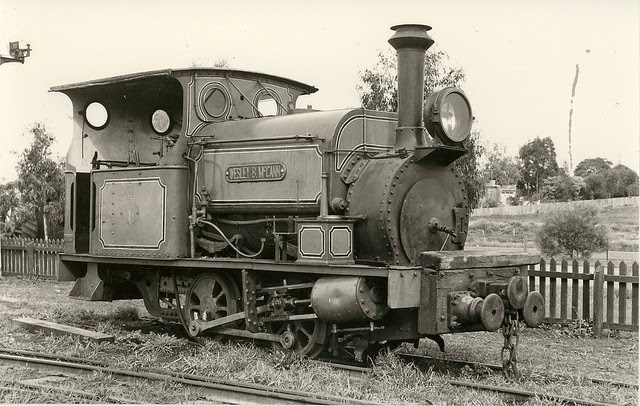
The second was engine #6 - a 0-4-2ST built in 1903 by Hudswell Clarke & Co., Leeds, England. It and three others were originally used in South Australia by the Wallaroo and Moonta Mining and Smelting Co. Ltd in their copper mines but were purchased for use at the cement works when the copper mine closed.
Engine #6 at the Fyansford Cement Works.
Taken from: http://www.brownfam.com.au/ROLL50/ROLL50.htm
Looking at photos of engine #6 during its time on the Belmont Common Railway, it is seen sporting the name "Wesley B McCann" which was the name of the manager of the Fyansford Cement works, however at the works, this was the name used by the diesel engine and not (as far as I can tell) by #6.
Engine #6 at Belmont Common Railway. Taken from the Stephen Haby
Collection, National Library of Australia
Initially it was intended to extend the Belmont Railway in a full loop around the common and back along the river with a further extension planned to take the line towards Queen's Park, but after the track was several times affected by flooding along the river, it became clear that this plan was unfeasible.
Engine #6 pushing a tourist service on Belmont Common.
Taken from http://www.brownfam.com.au/ROLL110/ROLL110.htm

Fortuitously however, in 1976 the decision was taken to close the Geelong-Queenscliff branch line and the Belmont Common Railway took the opportunity to move operations to Queenscliff. Fundraising during 1976 and 1977 along with a government grant enabled the line to be regauged to the narrower 3ft 6in used by the Fyansford engines and in May, 1979 the first services ran, carrying tourists between Queenscliff and Laker's Siding on the reopened line which was soon extended to Drysdale Station.
Today, from its humble beginnings on the Belmont Common, the Bellarine Railway has expanded to include engines and rolling stock from across the country and in recent years, the six surviving steam engines from the Fyansford Cement works have been reunited on the Bellarine Railway.

18 December, 2011

Hide and seek

The Jerringot Wetlands are of interest at the moment as much for  what I can't see as what I can. With the spring rains, the plant life is flourishing and the fauna is abundant. Part of the problem however, is that all this lush growth is making it rather tricky to see much of what is going on.
As a general rule, rain means frogs and frogs mean snakes. We had the rain, the frogs arrived and so did the snakes. Great! Rain also means grass. Nice, lush grass; good for hiding frogs and snakes.
Australasian Grebe amongst the reeds at Jerringot
Away from the water's edge, the aquatic plants are so abundant that it is becoming difficult to see much of anything from the bird hide. Whilst no doubt thankful for the extra cover, the coots and moorhens must be finding it hard work to paddle their way about - as for the ducks, I'm surprised they bother!
Of course, if it is tricky to see the birds which are abundant and generally easy to spot, how hard then, is it to see the birds that don't wish to be seen? Very! The information boards conveniently placed at strategic points around the wetlands, inform me that during the summer months, I should be on the look out for crakes, rails and the internationally protected Latham's Snipe. They say that I need to be patient and still - why do I always seem to be attracted to hobbies which require patience?
Well, I have been patient and I have been still and I have had...a limited degree of success.
Buff Banded Rail at Jerringot
Over the past couple of months my patience paid off with sightings and photos of several Buff Banded Rails which do indeed run across the path, right where the sign says they might and even in a few other places besides. On one occasion I even spotted a rail on the opposite side of the Barwon, hanging around in a patch of rushes not far from one of the factories which back on to that part of the river.
Within a similar time frame, I found that often as I walked down the path near the golf course, a number of birds would break cover from the grassy area, fly up and then re-settle a short distance away. Last week, I decided to be a little more careful. I approached slowly and was not surprised as a couple of birds flew up out of the undergrowth, then a couple more and a couple more.
Latham's Snipe at Jerringot
After a few attempts which saw me photographing a patch of weeds and an obligingly immobile and vaguely bird-shaped log, I spotted my quarry. It was standing at the edge of a clearing attempting - with some degree of success - to look like a piece of bark.
It turns out, I had managed to snap a Latham's Snipe - a migratory waterbird which spends its breeding months in Japan before heading south to spend the warmer months from September to February in the eastern states of Australia. These snipes are waders, with long, pointed bills which they use to probe mud and water looking for food.
This species which used to be hunted as game in Australia is now protected as part of an international agreement with Japan.
So, I have seen rails and snipes - that leaves crakes. There are three types to choose from but so far, I have failed to see a single one - unlike the local naturalist Trevor Pescott whom I note in a recent article managed to snap a shot of a Baillon's Crake near the bird hide.
Clearly I need to spend some time sharpening my skills as a stalker...

03 December, 2011

Hop to it!

Whilst the recent rains have been good for our gardens, they have not been entirely beneficial for the river and its inhabitants as I mentioned in my last post. There is one group of river-dwellers however, for whom the deluge has been a boon. These are the frogs which live in and beside the Barwon. In the days following all the rain, I was at Jerringot Wetlands and the first thing I noticed was the almost deafening increase in the frog noise.
Spotted Marsh Frog Spawn at Jerringot Wetlands near
Barwon Valley Golf Course
They seemed to be everywhere, which is great news for the Barwon and surrounding wetlands but perhaps just a little surprising given the amount of pollution I found in some places. As everyone knows, frog populations are very sensitive to the presence of pollutants in their habitats, but these little guys were croaking away regardless.
In fact, not only were they making a racket, they were also leaping into their breeding cycle with alacrity. When I looked closely in amongst the reeds and rushes at the edge of the Barwon Valley Golf Course, it seemed riddled with frog spawn. The conveniently placed information board next to the path informed me that as far as frogs went at Jerringot, I had four species to choose from. They were the Common Eastern Froglet, the Growling Grass Frog (Warty Bell Frog), the Ewing's Tree Frog (Southern Brown Tree Frog) and the Spotted Marsh Frog.
Spotted Marsh Frog spawn in drain leading from
Gravel Pits Road to the Barwon River
I was soon able to identify the frogs eggs I was seeing as belonging to the Spotted Marsh Frog, both from their appearance and the calls I was hearing in the vicinity. The sign also informed me that this frog has a call like two stones being knocked together which is a very apt description indeed.
Great! So I could see the eggs and hear the frogs...but finding a specimen was another matter entirely. Between the murky water and overly long grass, it seemed that I didn't have a hope. And up to the present point, that continues to be the case.
It is now a week since we had all the rain. The ephemeral water supplies are gradually receding, leaving some of the eggs high and dry and the frog noise, whilst still there is noticeably reduced.
Of course, the tiger snake who appeared beside me in the grass at Jerringot today was probably fairly keen to reduce the frog noise himself - frogs being their dietary staple. Hmmm...pity I didn't read that bit on the website about tiger snakes often being found close to frog habitats before I went looking for frogs!
So, for now, the quest to photograph some of the Barwon's hoppers continues...

29 November, 2011

Eeewwww!!

Up to now I haven't really looked at the environmental issues which affect the Barwon River, however with Saturday's deluge of rain, pollution has suddenly become a hot topic - well, for the next few days. The Geelong Advertiser informs me that for several days it will be unsafe to swim in either the river or Corio Bay. The reason for this is that the recent downpour caused the sewage system to overflow into the stormwater drains as well as sending a great deal of rubbish into the drains,  meaning that output from the stormwater drains may be contaminated. Not only is this bad news for humans who can suffer a range of unpleasant symptoms, but it is also a problem for the river environment in general.
Stormwater drain near Queen's Park
Large influxes of "nutrients" combined with the right weather and low water levels create ideal conditions for outbreaks of blue green algae along the course of the river. So what is blue green algae? It is actually a type of cyanobacteria, which as a group may well be the most successful micro-organisms on the planet. These tiny bacteria are thought to have given rise to the process of aerobic metabolism used by all higher life forms as well as forming the basis of chloroplasts - the part of a plant which it uses to make food. Cyanobacteria convert water into oxygen and energy by photosynthesis and it is through their actions some 3.8-2.5 billion years ago that Earth's oxygen-rich atmosphere developed. Cyanobacteria are also able to "fix" nitrogen and carbon. That is, they use the nitrogen found in nitrates, nitrites, ammonia and urea as well as carbon as part of their growth cycle.
Jerringot Wetlands
Whilst these effects are vital for the planet as a whole, contributing significantly to a reduction in greenhouse gasses, in a river system such as the Barwon, they can have negative effects. This is because the cyanobacteria use the chemicals which wash into our waterways to multiply. The result is an algal bloom which can result in a reduction in the amount of oxygen available in the water (eutrophication), which harms fish and other fauna. At the same time, cyanotoxins are produced which are toxic to humans and animals which live in and along the river.
Symptoms of poisoning in humans can include skin irritation, dizziness, numbness around the mouth, tingling in fingers and toes (produced by neurotoxins). Longer-term effects can include nausea, vomiting, diarrhoea and liver dysfunction. Animals can experience weakness, staggering, difficulty breathing and ultimately death.
So what are the "nutrients" in question and where do they come from? The primary chemical culprits are nitrogen and phosphorous. In urban areas they can be found in pollutants such as leaf litter from exotic trees (particularly in autumn), human sewage, animal waste, grass clippings, paper, detergent and industrial byproducts while in rural areas crop fertilizers can also impact on the levels of nitrogen and phosphorous in the water.
Pollutants on the surface of water at Jerringot Wetlands
...at Jerringot Wetlands
Other threats to river health and to its flora and fauna come from various sources. Pesticides used to control weeds or insect infestations in crops can be carcinogenic to humans if allowed to build up in drinking water supplies whilst non-biodegradable rubbish can cause physical harm or poison river users and wildlife.
Rubbish in the Barwon near Breakwater
Grass and other rubbish washed up during the recent rain
There are some factors however, which work to counteract the effects of pollution on the river system and one of the most important is the reed beds which filter stormwater runoff before it reaches the river. In the case of the Barwon, this includes not only the reeds and other aquatic plants which line the riverbanks themselves, but also the plant life in the wetlands adjacent to the river.

Reed beds at Balyang Sanctuary
Aquatic plants at Jerringot Wetlands
I have looked at a number of these in previous posts. Much of the stormwater from Belmont is collected by Jerringot Wetlands, whilst that from Newtown flows into Balyang Sanctuary. Most of Leopold's runoff drains into Gateway Sanctuary and Ocean Grove's into Blue Waters Lake. All of these wetlands ultimately drain into the Barwon River. In many places however, Geelong's stormwater flows directly into the Barwon with no intervening wetland to reduce the level of pollutants entering the river.

19 October, 2011

Another hidden gem

Today I rediscovered a lake which I had not visited for more than ten years; and in the bright sunshine of our first 30 degree day of the season, Blue Waters Lake in Ocean Grove did indeed sparkle like a jewel - a sapphire.
Blue Waters Lake, Ocean Grove
This very pretty little lake is another of the wetlands which drains ultimately into Barwon River. It has been substantially developed in recent decades, but was originally a natural lagoon. Like Balyang Sanctuary, Jerringot Wetlands and Gateway Sanctuary, it now filters stormwater, trapping harmful pollutants before they can end up in the larger river system. A City of Greater Geelong council report from 2003 acknowledges the vital importance of the lake in collecting and treating a significant proportion Ocean Grove's stormwater runoff and looks at ways to improve water quality. It also recognises the value the local community places on the lake as a recreational facility.
Hardhead Duck
Like the other wetlands along the river, Blue Waters is home to a sizable bird population. Today I noted at least a dozen species after only a cursory check, including quite a number of Hard Head Ducks. The only other place I have seen hard heads was a pair at Jerringot Wetlands a few months ago. Aside from a tendency to dive every time I attempted to take a photo, they were reasonably unconcerned by the presence of people.
Unlike the other wetland areas along the river, Blue Waters has a substantial number of non-native plantings, which whilst probably not helpful environmentally, make the lake significantly more attractive. These include quite a number of large willows at the water's edge which along with interspersed native plantings screen out many of the houses which border the lake.
Today's walk did not see us complete a lap of the lake, so I will return in the not too distant future to take a few more snaps and count a few more birds.

A hidden gem

Gateway Sanctuary, Leopold
Tucked away next to the busy Bellarine Highway is a sanctuary. I had driven past this place for years without noticing it was there, until a recent excursion landed me in its midst. Called the Gateway Sanctuary, it is located in Leopold on the corner of Melaluka Road and the Highway.
This little pocket of parkland consists of a series of shallow lakes and islands connected by wooden bridges with unsealed walking tracks in between.
Gateway Sanctuary, Leopold
Stormwater drains into the complex from nearby areas of Leopold situated to the north of the highway and - as is the case with other such wetlands - the flora and fauna which thrive here act as a biological filter, cleaning the water which passes through. Whilst this naturally swampy area is now a man-made rather than a natural wetland, it didn't take long for me to discover that water from the sanctuary drains into Reedy Lake and ultimately into the Barwon, thereby qualifying this hidden wetland as a suitable topic for this blog.
Like the Jerringot Wetlands and Balyang Sanctuary further up river, the Gateway Sanctuary is located at a distance from the river/lake but boasts the usual array of bird life. A quick count on a couple of occasions has so far turned up about twenty-four different species of birds, all of which I have seen on other parts of the river at one time or another.
Black swan and sygnets at Gateway Sanctuary
Possibly the most interesting inhabitants at the present time are a family of black swans who are by far the biggest birds around. Why they have chosen this small wetland as their home, rather than the much larger expanse of Lake Connewarre as many of their compatriots have done, I have no idea.
Due to its location, this park is a strange mix of urban and rural. Periodically and in sequence with the traffic lights, noise from passing traffic overrides the more natural bird noises which predominate in quiet moments, whilst a short distance away, the calls of sheep and cattle from adjacent farmland provide a further interruption to the sounds within the park.
Somewhat disappointingly, I can find very little information about the establishment or development of the sanctuary, so if anyone knows more please fill me in.

29 September, 2011

Rain, rain come again!

...and boy did it rain! I had intended to go for a run all day and for a variety of reasons, wasn't able to get out there until late afternoon. The weather was overcast but still quite mild. There had been a little rain on and off during the day, but nothing too major.Of course, as soon as I changed into my running gear, the lightning started. But as there was little rain about and whilst overcast, it looked to be clearing from the south, I headed out anyway, following my usual route down to the Barwon. Clearing? Who was I kidding? By the time I got about 5km into my run, it was pouring. We haven't had rain like that in ages - big, heavy, wet drops and it didn't let up. It was however, probably the best time to be running. The temperature was still remarkably mild, there wasn't much wind and the rain was keeping me cool.
It felt later than it was - more like 6pm than 5pm - but I wasn't the only one making the most of the conditions. I passed the odd cyclist and a couple of intrepid walkers as well as several other runners - with one exception all male.
This got me thinking about two things. Firstly, I wondered as I often do, about the optimum conditions for running. Over the years, I think I've encountered most of them, such as they are in this part of the world, and my conclusion is that if it is too cold to start running, then I am more likely to have a good run. However, if it is not so cold that I don't want to start running, then I will very soon find it too hot to run comfortably. Great! Either I won't run because it's too cold, or I can't run because it's too hot. My current solution to this problem seems to be running during thunderstorms. Any breeze is cooling, but not freezing, the rain is refreshing and perhaps all those extra ozone molecules zinging about add some extra bounce to my step - assuming of course, I don't get hit by a stray lightning bolt.
Stormwater runoff
The other downside to running in the rain which became increasingly apparent on this occasion, was the issue of water runoff across the path. By the 7km mark, my ultra lightweight running shoes were anything but, by the 9km mark I could hear squelching noises with every step and then, at around the 11km mark I landed in a pothole which meant one foot was now completely saturated as high as my ankle. Regardless of this, I finished the run in reasonably good shape and hit the shower to dry off - let's face it, it was wetter outside at that point!
But what do the experts say about weather and running? From what I can see, the "optimum" temperature range for distance running is between about 5-10 degrees Celsius. Great! I'd rather be home in front of the heater! But I do have to admit that they are pretty much correct. Assuming I can drag myself out there, my best times tend to be in the cooler weather - anything below about 15 degrees will do, except in the case of rain for the reasons I outlined above. Some experts contest that running in cold weather can actually hamper the ability to run as performance is compromised by the need to generate heat to warm the body, however I suspect they have cooler temperatures in mind than those along the Barwon.
Yesterday a torrent, today a trickle
Heat of course, is a detriment to running. Too hot and you run the risk of hyperthermia (elevated core body temperature) leading to heatstroke and organ failure, dehydration and electrolyte loss through sweating, or sometimes even hyponatremia (decreased body sodium levels) due to over hydration. None are a good alternative and as I have trouble drinking and running at the same time - water is not useful when inhaled - I tend to avoid running in the heat. Either I go early, late or not at all unless I misjudge the temperature, in which case I suffer.
The other thing which was glaringly obvious as I made my way round the river was the water runoff. Not only for the fact that most of it seemed to be happening via my ASICS, but also because of the very apparent volume of water which was making its way into the river. As I neared Queen's Park, I passed a stormwater drain which was discharging water with the velocity of a small train. On my way back, I noticed a similar drain on the opposite side of the river had taken on the proportions of a waterfall and then, as I neared King Lloyd Reserve, there appeared to be a small geyser spouting from the lawn - perhaps a pipe had ruptured under the weight of the deluge.
Balyang Sanctuary
Along this section of the river, the water collected from surrounding catchment areas, just feeds back into the river itself and joins the larger flow, however on other parts of the river, stormwater plays an important role in maintaining local eco-systems. Balyang Sanctuary and Jerringot Wetlands are both excellent examples of habitat maintained by storm water runoff. Balyang takes its water from 70 hectares of surrounding residential land, whilst Jerringot is supplied from a large area extending up the Belmont Escarpment as far as Roslyn Road. The careful planting of native flora at Balyang Sanctuary - and presumably also Jerringot - contributes to a significant improvement in the quality of stormwater reaching the Barwon

09 June, 2011

Good weather for ducks!

...or so you'd think! In my quest to photograph as many of the different species of birds which frequent the Barwon and its surrounds as I can, I headed out yesterday in the hope of a) perhaps spotting one of those species of ducks I mentioned previously that I haven't managed to find and b) catching a glimpse of one or two of the various birds which overwinter along the river. This was despite the weather which did not exceed 11 degrees for the day and was intermittently either windy, pouring with rain, sunny or a combination of any of the above.
View towards the eastern suburbs of
Geelong From Tait's Point
I started at Jerringot which is supposed to boast 120 different species of birds throughout the year and then moved on to Tait's Point. Well, Jerringot had the usual Chestnut Teals along with moorhens and swamphens and a single Australasian Grebe, but even the swans it seems didn't want to be out and about. Well short of 120 species.
Tait's point wasn't a whole lot more successful. Not long after I arrived, a number of birds started wheeling overhead. At a glance they were ducks, but what variety I have no idea, and thanks to the two council employees with their tractors who chose to park their vehicles for lunch at the top of the boat ramp, the "ducks" weren't hanging around to let me identify them.
Meanwhile, one solitary swan was drifting around off the shore and two jetties and a log boasted cormorants - Little Blacks and Little Pied. (Incidentally, the collective noun here it seems is generally a "flight" of cormorants, however I did see a "mess" and a "gulp" suggested, which are much more amusing - to me anyway. I doubt the cormorants care either way.)
On a slightly more successful note, I may have spotted an egret trying to hide amongst the cormorants. I wasn't close enough to get a decent photo so my criteria for identification were a large (in comparison to the cormorants) white blob, with a pointy yellow blob where the beak should be and no sign of legs, which I took to mean they were grey.
Galahs at South Barwon Reserve
Back on shore, the Superb Fairy Wrens were out and about despite the weather and chattering at me from up in the paperbark trees were Striated Thornbills which I could see and hear, but which made sure they didn't sit still long enough for me to get a shot of them.
On the way home, I detoured past the South Barwon Reserve to have a look at the bottom end of Waurn Ponds Creek where it enters the Barwon. There were a large number of bullrushes, lots of soggy ground and I really couldn't get close enough to see where the creek entered the river. Instead I amused myself taking photos of the Straw-necked Ibis who had decided that one of the ovals at the reserve was their personal feeding ground and a pair of rather brightly coloured Galahs who weren't overly concerned with my presence.
So much for the birds. What of the weather? There are various websites which give chapter and verse on the effects of rainfall on the Barwon River system: for example, the City Of Greater Geelong website. It would seem that on a wet catchment - which I imagine is currently the case - 75mm of rain over a few days is enough to cause flooding, or 150mm when the catchment is dry.
Certainly, the prolonged drought and accompanying weather patterns from which we have just emerged have had a drastic effect on the health of the river and its denizens. A 2007 study by Deakin University examined the problem, indicating that reduced water flows would impact on salinity levels and plant life, in turn impacting on food sources for fish and water birds. For residents of Geelong and surrounds, there was the obvious impact of water restrictions as levels in the West Barwon Dam fell.
Fisherman at Barwon Heads
However, it is not only the river height and those of us who run, walk, ride along it which are affected by the weather. I am informed that redfin - an introduced species of fish common in the Barwon and which I have fished from the Moorabool River myself in the past - are also sensitive to the weather on a day to day basis. It seems that they like a rising barometer and fine weather - don't we all? Under these circumstances the fish are biting and a good catch is likely. When the barometer is falling, the fish are likely sulking on the bottom of the river and not about to be enticed by a tasty worm or a flashy lure. My own observations suggest that in general, the bird life is no more keen on being out and about in bad weather than the rest of us. It is only the hardy, the hungry or the waterproof who brave wet and wintry conditions and with the forecast for the coming week providing no sign of relief, I may have to wait a while to find those ducks.
And of course, I am now left wondering...what exactly is "good weather for ducks?"

09 April, 2011

Jerringot

Jerringot Wild Life Reserve
For years I have driven past the Belmont Common, not really paying attention to the reedy, swampy land to either side. Yes, there were a few bird breeding boxes and I knew that it was low-lying and inclined to flood at the first sign of rain. Presumably it connected to the Barwon in some way or other - but how  and what was really in there?
I discovered the answer to these questions on a recent ride to Waurn Ponds - which incidentally is made somewhat complicated at present due to the road works which are being carried out for the Breakwater Road re-alignment and have resulted in the closure of the nearby bike tracks. Nonetheless, hidden in plain view I found the Jerringot Wildlife Reserve. Wedged between the Princes Highway and the Barwon Valley Public Golf Course, it provides a haven for waterbirds and other small animals. According to signage at various points around the reserve, the area is part of the Belmont Common Flood Plain. Water flows from the Belmont Escarpment above into the wetlands which originally consisted of Billabongs and Jerringot Creek which drains into nearby Waurn Ponds Creek. This in turn flows to the Barwon River.
I am also informed that there are up to 120 species of birds to be found within the reserve most of which I have so far - frustratingly - been unable to locate. Incidentally, this is almost double the number of species I have identified on other parts of the river to date. In typical fashion, I arrived in time to discover that the internationally protected Latham's Snipe - a wading bird which chooses to spend its summer vacations in Belmont - had most probably packed its bags and headed home to Japan about two weeks before I got there. Perhaps I will have more success with the Cattle Egret which is due to arrive any day now.
Black Swan at Jerringot
The Belmont Common was also significant to the local Wathaurong population who used the area as a meeting and camping place, taking advantage of the abundant local plants and wildlife to supplement their diet. Fish, shellfish, crustaceans, root vegetables, seeds, grains and a variety of land animals all formed part of the menu. The name Jerringot is a local Wathaurong word meaning "place of Billabongs". The Jerringot ecosystem is reliant upon regular cycles of drought and flooding to maintain the variety of animal species which live here including frogs, insects, birds and reptiles.
Clearly I have much to discover about this little pocket of the Barwon's ecosystem and will have to spend further time investigating in the near future.