Showing posts with label geocaching. Show all posts

28 April, 2015

Keep it clean!!

This week-end, I had the opportunity to combine two of my favourite pass times: paddling on the Barwon River and geocaching. For those who haven't seen my earlier posts on the latter subject, geocaching, as defined by geocaching.com is "a real-world, outdoor treasure hunting game using GPS-enabled devices". Generally, the geocacher (cacher for short) would be attempting to locate a container with a log book which they would then sign before logging their "find" online.
This geocaching adventure however, was a little different. It was a "Cache In Trash Out" event cache (aka a CITO) at which participating cachers log their attendance and then spend some time cleaning their surroundings of litter or weeds or undertaking other environmental initiatives such as tree-planting.
This particular CITO was timed to coincide as closely as possible with Earth Day (22nd April) around the world, recognising the need for environmental action. This CITO held in our little part of the world, attracted a small group of determined kayakers who were keen to remove as much junk from the Barwon as possible.
The crew assembled and ready to paddle
Naturally, given my recent personal efforts in that direction, I was very keen to participate. At the appointed hour, a group of around a dozen of us gathered and hit the water at the boat ramp opposite the boat sheds. The weather was cool and overcast, but clear and not too windy as we worked our way along both banks, downstream of our starting point.


Hard at work on the south bank
The junk to be found in this part of the river is a little different to what I have been finding further upstream. Whilst there were still a lot of plastic bottles, there were also significantly more small pieces of plastic - wrappers, bags, forks (?!), Styrofoam, bags of dog droppings - and even at one point, a number of City of Greater Geelong parking tickets.

The final haul
In all, we were on the water for somewhere near an hour and covered an area a few hundred metres down stream from the boat ramp. The end result was the pile in the picture above. Not a bad effort, however we could easily have continued for much longer and for a much greater distance.
Whilst much of the litter we retrieved was no doubt the result of careless behaviour by river users both on the water and on the bank, some of it had washed in from stormwater run off. This was certainly the case with a collection of bottles and plastics I found near a drain entry point.
It is probably also worth noting, that this is not the first time that Geelong's geocaching community have banded together to tidy up our waterways. at the end of 2013 at what I believe was Geelong's first CITO event, a huge effort was made to clean up along the banks of the Moorabool River at Fyansford.
Fyansford CITO along the Moorabool December, 2013
Working only from land on that occasion, a huge amount of rubbish, including dumped furniture and significant amounts of household rubbish was removed from the area and from memory, we only scratched the surface on that occasion. Whilst illegal dumping seemed to be a large part of the problem here, the irresponsible dropping of litter seems to be more of a problem on the Barwon - especially through town.
The occasional CITO may not be much, but it is a start and hopefully if more people become aware of the problem, steps can be taken not only to clean up the rivers, but to prevent rubbish from entering our waterways in the first place. These days when I paddle, I always take some rubbish with me when I leave. If everyone who used the river did the same, or though about how they disposed of their litter it would be a much cleaner place.

10 June, 2013

Run Forrest!

And run we did!
This Queen's Birthday weekend saw the staging of a new event on the Barwon: the inaugural "Run Forrest" and naturally, I had to be a part of it!
The calm before the storm. West Barwon River
It was my first official trail run over the half marathon distance. I was seriously underdone training-wise both for the distance and the hills and definitely lacking in pretty much any sort of proper trail running experience. None-the-less it was a great thing to do. With a finishing time of 2:16:40, I was never going to break any records - not even my own - but that wasn't really the point.
Waiting...
The point was to get out and run along parts of the Barwon I either hadn't seen before or hadn't run along. Some of the route I knew quite well, such as the track below the West Barwon Dam and that around Lake Elizabeth, but other sections I hadn't seen.
...still waiting...
...and GO!
Well, Forrest really turned it on. The weather was perfect; clear, cool and without a breath of wind. From what I could glimpse, the surface of Lake Elizabeth was as smooth as glass. This really was a stunning backdrop for a running event and I would love to say that I spent the whole distance admiring the view. The reality was however, that I spent most of the time paying very close attention to the path in front of me or the feet of the runner in front as I tried to avoid the very real risk of a sprained or broken ankle - such are the joys of trail running. However I did remind myself to take an occasional glance as I slowed down a little for the uphill sections, of which there were many!
..and here's one I prepared earlier...Lake Elizabeth December, 2011
It also meant that I did not carry a camera which was a good decision as the majority of the run was on narrow, single-person mountain bike trails with little room to stop or overtake. None-the-less, it was a great run with only one seriously murderous hill as we climbed up the "Red Carpet" trail from the East Barwon back to the West. All the other hills were relieved by short sections of flat or downhill.
The track around Lake Elizabeth December, 2011. It was a little damper than this
As well as being a new thing for me, the whole event was a learning curve both for the organisers and the good townspeople of Forrest. For those who didn't run, there was a band, a few stalls selling food and merchandise, coffee or a meal in town, the opportunity to take a stroll along the West Barwon to the dam and for those in the know even a couple of little log books to be discovered and signed.
For the runners there were the usual check in facilities, race support and post race recuperative beverages. There was also a rolling results tally which was updated as runners finished and displayed on screen which was kinda fun.
Done!
After the event, it was - fortunately - a short walk up to the main street and a wander through the 8th annual Otway Soup Festival before nabbing a table at Forrest Country Guesthouse for lunch. The guesthouse along with every other eatery in town was run off its feet, however the staff were holding up admirably and were still smiling by 3pm when the crowds were beginning to thin a little.
All in all, a great event!

16 July, 2011

Kookaburras, Cameras and Caches

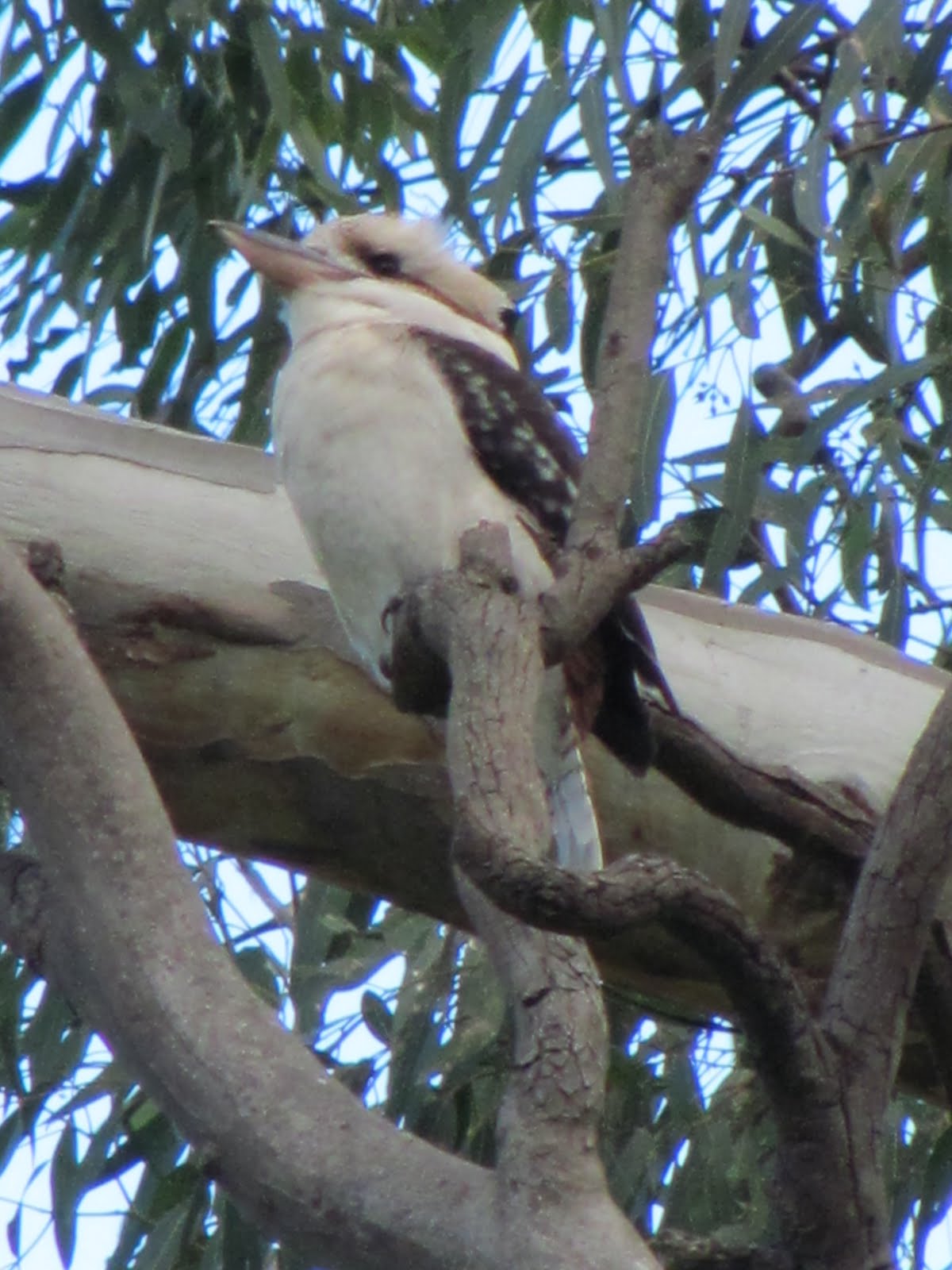
Laughing Kookaburra at Queen's Park
On a few rare occasions as I have walked along the river, I have heard a kookaburra laughing from the trees; once or twice in the Newtown area of Geelong and once out of town. Prior to the last few days however, I had never never actually managed to see one on the river, but as I climbed out of the car at Queen's Park on the trail of yet another geocache, I heard a familiar sound. Fortunately I had my camera to hand (playing the ammateur photographer makes a convenient cover when hanging around the one spot for extended periods of time - often a requirement when scrounging around in the undergrowth looking for some obscure plastic container, designed not to be found).
A quick scout around and I soon located the source of the call, sitting - yes, you guessed it - in a gum tree. The  cache unfortunately was nowhere near as easily located.
The kookaburra (more correctly, the Laughing Kookaburra) is a larger member of the kingfisher family. It is quite distinctive in both voice and appearance and therefore not easily confused with other birds, except with the Blue-winged Kookaburra which is found in the north of the country.
The word kookaburra is believed to have come from the Aboriginal word guuguuburra used by the Wiradjuri people of New South Wales. It is considered onomatopoeic, meaning the word mimics the sound of the bird's call which is not actually a "laugh" but usually a territorial warning to other birds to stay away. Family groups will often "sing" together in a chorus.
Laughing Kookaburra on the Barwon River
This particular specimen appeared to be alone and was happy enough to just sit and watch me while I snapped my shots and scrambled around under the bridge, trying no doubt unsuccessfully, not to look suspicious. It on the other hand, was doing a much better job of blending in with its surroundings, perched on a dead branch looking, I imagine, for its next meal - an insect or worm or perhaps something larger like a frog or even a small bird. Hopefully the small snakes, which are also a preferred food source, are in fairly short supply at this time of year!
Kookaburras I discover, can be rather brutal in dispensing with their larger prey, beating the happless animals to death against a conveniently located firm object such as the ground or a tree branch.
I don't know how long it stayed in the tree, but there was no sign of my new feathered friend the following day at which point I did eventually find what I was looking for.

16 June, 2011

The thrill of the chase!

I have often considered the number of different sporting activities which take place along or beside the Barwon. Some are fairly obvious, such as swimming, water skiing, rowing, kayaking, dragon boating and canoeing which all take place in the water. Fishing generally happens from the bank whilst running, walking and riding take place on the trails beside the river. At a little more of a remove, golf, cricket, football and athletics are all played at venues located alongside the river whilst the children's playground and gym equipment at Barwon Valley Fun Park (currently undergoing renovations) provide further opportunities for exercise.However, I have discovered another sport - I guess you'd call it that - which is played along the length of the river and beyond. This is not a spectator sport with cheering crowds of supporters, referees or timekeepers. In fact no-one is supposed to see it happen at all and once finished, the participants are required to leave no trace of their passing. Those who are not playing are not to know the game is afoot and yet anyone can participate.
It is secretive, cryptic and often complex to play. It requires mental acuity and in some cases physical dexterity and endurance. All levels of fitness can be accommodated. Participants may not always reach their goal but withdrawal through injury is unlikely. Whilst there is no time limit - minutes, hours, days, months, even years are acceptable - it can none-the-less be quite competitive. There may be a prize for finishing first, or none at all. There are rules, but no-one will be present to ensure they are enforced.
 It is an international sport, played across all continents by more than 5 million participants, but it is not an Olympic sport. It can be played individually or in teams and at any hour of the day or night. Participants may have no idea how many others - if any - are playing and there are no age or gender requirements. There is no limit to the number of people who can play at any one time.
There are no uniform requirements, but protective clothing is sometimes advisable. Specialist equipment is a virtual necessity and a variety of tools can be helpful.
Of course, in any sport, there are terms and phrases which allow players to communicate. This sport is no different:
GZ = Ground Zero.
Muggles = those uninitiated who are not aware of the game.
BYOP = bring your own pen or pencil.
D/T = a rating of difficulty and terrain 1 = easy 5 = hard.
TNLN = Took nothing. Left nothing.
FTF = First to find.
These are only a few examples. There are many more.
So what is this sport?
It is known to initiates as "geocaching". Wikipedia gives a good description here but in short, it is the 21st century's version of hide and seek.
There's a geocache here somewhere!
Using clues, coded messages and a GPS device, players locate hidden "caches". A cache is generally a container with a logbook inside which is signed by the player to indicate that they found the cache. Players also report their "finds" online, keeping tallies and letting others know what they thought of that particular cache. Caches may also contain items which can be moved from one cache to another by players or traded for other items of similar value. In this way, some items have travelled across the world.
There are currently more than 1.4 million active caches for players to find. Anyone can hide and maintain a geocache but a certain amount of experience is probably necessary to know what constitutes a "good hide". Various websites like www.geocaching.com list caches making it relatively simple to determine which are nearest to you.
Which brings us back to the Barwon. There are several currently active geocaches located along the river at various points from West Barwon Dam to Barwon Heads and no doubt beyond and most seem to have been active quite recently. A quick search of my own postcode revealed 361 geocaches within that region alone - not all on the river of course, but several are.
Some players like to search at night, no doubt the extra degree of difficulty adds to the challenge. So, it would appear that on any given day - or night - there may be an undisclosed number of individuals marauding along the banks of the river hunting for treasure.
Amazing what goes on while you're not looking!