Showing posts with label Ballan. Show all posts

16 November, 2013

Branching out - a Bavarian invasion


The von Stieglitz family of Tasmania and Victoria were descended from Christian Ludwig von Stieglitz who was created Baron of the Holy Roman Empire in 1765. The second baron - Heinrich Ludwig - son of Christian emigrated from Bavaria to Ireland with his family around the turn of the 18th century. However, following the death of the second baron in 1824, his wife, six sons and three daughters found themselves in straitened circumstances, consequently each of the six grandsons at one time or another sought their fortune in Australia. Biographical details for each can be found in the Australian Dictionary of Biography.
Of particular relevance to the Moorabool Valley are the three brothers - Robert William, John Lewis and the youngest - Charles Augustus. Robert along with his brothers Frederick and Francis arrived in Tasmania in 1829, with the others following in subsequent years. Unlike their brothers, John and Robert did not receive land grants in Tasmania but instead crossed Bass Strait with the earliest squatters to take up land in the Port Phillip district.
On 9th November, 1835, John von Stieglitz along with John Anthony Cowie and David Vere Stead were amongst the first settlers lead by John Batman to land stock at Port Phillip. They arrived from Tasmania on the ship Norval, landing at Gellibrand's Point (Williamstown).
von Stieglitz, Cowie and Stead were quick to head west in search of pasturage for their stock. In March, 1836, Cowie and Stead - I assume with the von Stieglitz's - took up a run at what is now the suburb of Bell Post Hill in Geelong, holding the land which ran down to the Moorabool River (see Branching out - from squatting to schooling).
About two months later on 3rd May, John von Stieglitz married John Cowie's sister Emma at her brother Robert's home in Tasmania. Soon after on the 9th July, he arrived at Point Henry with more stock for their run.
By 1838 - already finding the rapid increase in population occurring with the settlement of the town of Geelong too restrictive - the brothers, along with Cowie and Stead moved their stock on to greener pastures further up the Moorabool River. Robert settled his sheep on 4,836 acres which he called Ballan (named for a town in Ireland) near the head of the eastern branch of the Moorabool River.
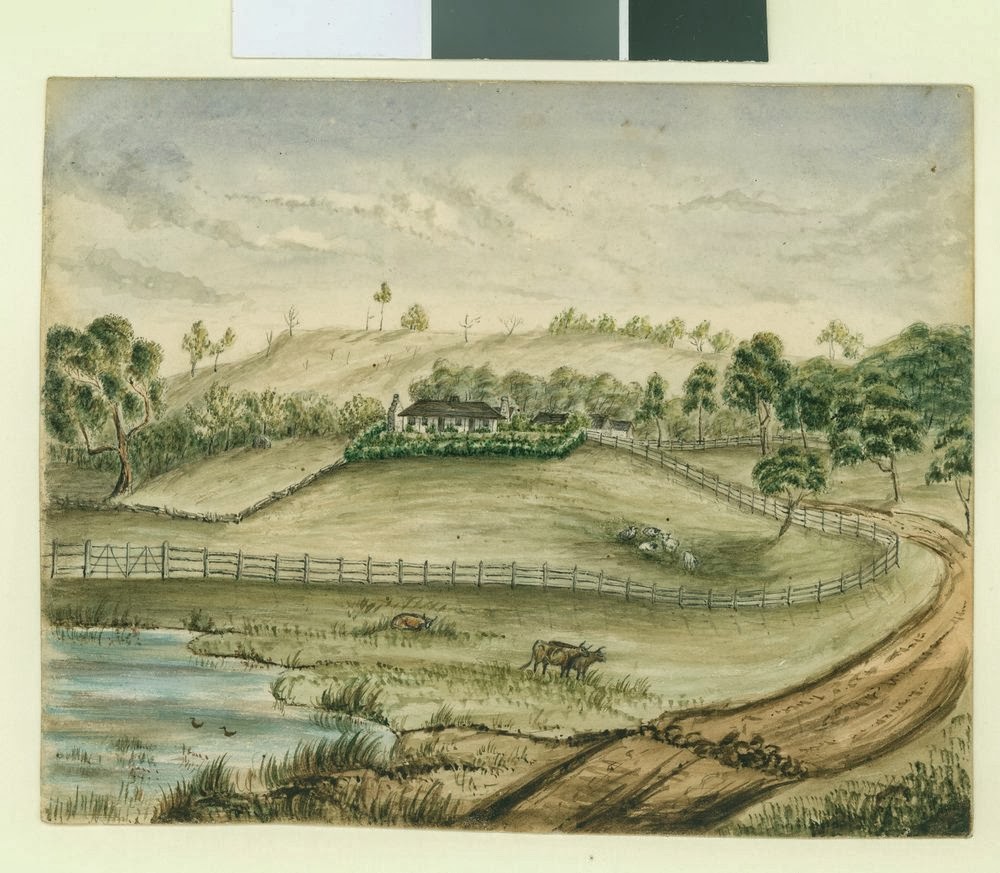
Ballan House, drawn by Emma von Stieglitz (nee Cowie). Image held by the
State Library of Victoria
Brother John and his wife Emma established themselves on 16,000 acres which they called Ballanee (aka Ballenee) nearby on the Werribee River. In 1842, ties between the von Stieglitz and Cowie families were further strengthened when John Cowie married the von Stieglitz brothers' youngest sister Charlotte Christina at Ballanee.
Ballanee, drawn by Emma von Stieglitz, Image held by the State Library of Tasmania
 Four years before his marriage, Cowie along with David Stead had taken up a third run, south of Ballan on the banks of the East Moorabool River. They called their property Bungeeltap - also the subject of an earlier post.
The third of the von Stieglitz brothers to take up a run on the Moorabool was the youngest son, Charles Augustus. He arrived in Victoria in 1839, having stayed behind in Ireland to complete his schooling. Prior to his arrival, and the same year in which they were establishing the original Bell Post Hill run near Geelong, Cowie and Stead also  took up a lease of 8,000 acres further up the Moorabool on its eastern bank. This land lay between what would become the Moranghurk run of William Taylor and Dugald McPherson to the south and John Norman McLeod's Borhoneyghurk to the north. They called the run Durdidwarrah a Wathaurong word which I have seen described as meaning either "shelter of bark" or "dead water".
In 1842, Durdidwarrah - now extending to 24,000 acres - was passed to  Charles von Stieglitz who established himself there, extending the run to eventually include 74,000 acres. During the 1840s, a simple residence was erected on the property followed in 1849 by a larger brick house with Georgian and Edwardian features. Both still stand today, the former as an outbuilding and the latter with alterations and additions made over the years.

Original building at Darra, 1962. Image from the J.T. Collins Collection, La Trobe
Picture Collection, State Library of Victoria
Like his brothers, Charles did not remain in Victoria, but in 1853 returned to Ireland a wealthy man. In October that year the property was advertised for sale including "The Eclipse Hotel"  and again the following year including "...the Steiglitz Estate in lots to various purchasers...". By 1858, the homestead was still in operation as the Eclipse Hotel, however mention does not appear in the contemporary media after that date.
In 1863 Durdidwarrah was purchased by William Thomas Napier Champ, the first premier of Tasmania, who changed the name of the property to Darra. Champ had also served as the Commandant of Port Arthur and arrived in Victoria in 1857 to take up the role of Inspector-General of Penal Establishments. Throughout his career in the justice system he was seen as a fair and humane figure. He retired from his public role in 1868 to Darra where he spent the remainder of his life developing the property, pursuing pastoral pursuits and playing a role in the local community. In addition to the 200 acre pre-emptive right purchased by Charles von Stieglitz in 1853, Champ added a further 1075 acres, most of it purchased in 1867 and then another 300+ acres in 1884. He died in East Melbourne in 1892.

Darra homestead, 1962. Image from the J.T. Collins Collection,
La Trobe Picture Collection, State Library of Victoria.
The property remained in family hands into the 20th century. In February, 1900 The Argus reported that there was a devastating bushfire which tore through the district, burning houses and stripping grazing land. Whilst the Darra homestead remained standing, all fences and grassland were lost - for the second time, it claimed, within only a few years.
Such setbacks notwithstanding, Darra remained in family hands until January, 1922 when, due to advancing age, Mr JW Champ sold the property, consisting of around 2,000 acres with all stock and plant.
By the 1930s Darra was in the hands of the prominent Austin family, many of whom owned properties in the region.
Whilst the Durdidwarrah/Darra Estate saw the usual pattern of squatting and grazing, followed by selection and closer settlement, geological circumstance meant that the development of a part of this run was unlike any other in the region. It has been said that whilst he was digging a well, Charles von Stieglitz discovered a rich gold reef. He immediately had the well filled in and nothing further was mentioned. However, in 1855 everything changed...

07 November, 2013

Branching out - settling in

From what I have seen of the earliest days of settlement along the three rivers, there were two types of squatters who came to settle "Australia Felix". All were graziers, bringing with them the stock they hoped would thrive in the new land. All were adventurers, often embarking on extended treks into territory unknown to Europeans in search of grazing land but not all came to stay.
There were those like Cowie, Stead, the von Steiglitz brothers and the Learmouths who came, established their runs over the course of the 1840s and then returned to the United Kingdom. Then there were those like Russell, Thomson, the Austins and many more who came, built permanent houses on their runs and often took on prominent roles in the communities which grew up around them.
So for this post, rather than focus on a single part of a river or a single property, I thought this time I would look at a particular person who was amongst the second group: Dugald McPherson.
Dugald McPherson. Image held by Museum Victoria
Dugald was a Scotsman, born at Ashens, Argyllshire on 9th September, 1820. In 1840, he and his brother Peter arrived in Victoria and that same year, along with William Taylor - another Scottish immigrant -  Dugald took up the squatting licence for the property Moranghurk on the Moorabool River, about 42km from its confluence with the Barwon at Fyansford. There they ran their stock and built a small timber cottage.
They remained at Moranghurk until 1846 when, together, they made the move to the Wimmera district where they took up land. In 1848 the run was divided between the two. McPherson named his 53,000 acre run Ashens for his hometown in Scotland, whilst Taylor's run was known as Longerenong.
On the 1st June, 1852 at Melbourne, McPherson married Mary (May) O'Cock, the daughter of a St Kilda solicitor. With his new wife, Dugald returned to the Wimmera where May became the first white woman in the district, where she was considered quite a curiosity by the local indigenous population.
Only two years later however, McPherson was once again on the Moorabool River when 1854 he purchased the leasehold of John Cowie's Bungeeltap West run, presumably along with the pre-emptive right to 640 acres of land along the river which Cowie had purchased that same year.
Looking northwest across the Moorabool East Branch to Bungeeltap land
from the driveway of Emly Park
Here too the McPhersons are believed to have interacted with the local clan of the Wathaurong tribe, with Mrs McPherson reported to have witnessed a corroboree at the township on "Ballan Flat". The name Bungeeltap of course is derived from a local Wathaurong word, however I have seen two quite different meanings for the name. The first claims the meaning as "spirit water" the second, "eagle's nest". I do not know which is correct, but Bunjil (aka Bungal) was the name given to the eagle believed by the Wathaurong to be the creator spirit and who dwelt nearby at Lal Lal Falls.
Whilst not the first Europeans to settle the Bungeeltap West land, the McPhersons were the first family to call it home. In about 1863 they built a two-storey stone house in the gothic revival style, overlooking the east branch of the Moorabool River. It was at Bungeeltap homestead that their eight sons and five daughters were born. Two of the children who died in early childhood - Norman aged 3 (died 1861) and Cluny aged 4 (died in 1871) - are buried on the property. A shepherd named Tim who died from a snakebite during John Cowie's tenure in 1840 is also buried on Bungeeltap land, beside the river.
Looking north west across Bungeeltap land from the Egerton-Bungeeltap Rd
As with most of the large squatting runs, when the land acts of the 1860s were enacted, Bungeeltap West was thrown open for selection. In addition to the land held as part of his pre-emptive right, McPherson also purchased a further 293 acres directly to the north along the river. Another 274 acres were also purchased in the name of his father-in-law, Richard O'Cock, giving a total of around 1,200 acres in family hands before the squatting licence for the property was finally relinquished in 1880.
Then in November, 1875, a notice appeared in The Argus stating that estate agents had "...closed the sale of Emly Park Estate containing 6,700 acres...to Dugald Macpherson(sic)..." thus it seems that for a while at least, Bungeeltap East and Bungeeltap West were again held by a common owner. I cannot be sure how long Emly Park remained in McPherson's hands, however I was able to discover that in 1900, Vincent Valentine Mogg of nearby Yallock Vale purchased the property which he owned until his death in 1843.
As well as a grazier, McPherson was an innovator and was keen to improve his property and his flocks and herds. He was the first in Victoria to use an "earth scoop" also known as a "leveller" - a horse-drawn machine, guided by hand which was used to level ground for irrigation. He had his machine made at a local foundry from a drawing he had seen in a book.
Over the years, the property became known for its fine merino wool and beef cattle. Horses and horse breeding were also of interest to Dugald who it is reported, would drive a carriage and four-in-hand when visiting either Ballarat or Melbourne. At Ballarat's first national agricultural show in 1868, his horses, cattle and ewes all appeared in the prize lists and his name regularly appeared in the stock pages of the newspapers throughout the 1870s, 80s and 90s.
Bungeeltap stables. Image taken 1965 by John T Collins. Image held by
The State Library of Victoria
The McPhersons were also particularly active in the growing community at Ballan. Dugald was a councillor on the Ballan Council from 1864-1873, served as chief of the Highland Society of Ballarat and along with others was a founding member of the Australia Club in Melbourne. He was a devout Presbyterian and was the driving force and principal benefactor behind the establishment of St Paul's Presbyterian Church, Ballan which held its first service on 22nd June, 1866. The building still stands today as the Ballan Uniting Church.
Ballan Uniting Church
Dugald's wife "presented" the central stained glass window which adorns the northern end of the church and also laid the foundation stone. Her efforts to start a Sunday school at their Bungeeltap homestead, resulted in the opening of Bungeeltap State School No. 1155 in 1875.
Northern end of Ballan Uniting Church showing the window
presented by May McPherson
Interestingly, despite their Scottish ancestry and involvement with the Presbyterian Church, at least one of Dugald and May's sons attended Geelong Church of England Grammar School and is listed amongst the old boys in a 1915 issue of the school magazine The Corian.
In addition to their support for the church, the McPhersons appear to have taken an active role in the sporting life of the district. On 26th January, 1889 the younger members of the family were host to a cricket team made up of Ballan residents who travelled to Bungeeltap by coach to compete against a side composed of seven of the McPhersons and a few of their friends. The match was preceded by a luncheon, following which, hostilities commenced on "the well grassed flat on the banks of the Moorabool, between the Emly Park home station and Bungeeltap house" - I imagine on the Bungeeltap side. Whilst, the ladies of Bungeeltap were said to have been avid spectators at the game, Dugald does not appear to have been a participant in the match which was won comfortably by the Ballan men.
In addition to his pastoral interests at Bungeeltap, McPherson also held licences for Nhill Station in Northern Victoria and Paddington Station at Cobar in New South Wales, whilst his father-in-law Richard also moved to live near the family at Ballan. This house - known as Westcott - also passed to the McPhersons upon O'Cock's death in 1883, with one source indicating that the family used it as their town house. Between 1914 and 1930, the house was used as a private hospital and the fourth McPherson daughter died "at her residence, Westcott, Ballan" on 4th May, 1924.
The remaining portion of Westcott, Ballan
Dugald died at Bungeeltap on 20th October, 1901, but the family remained at Bungeeltap for the next 15 years until May also died there on 14th August, 1916. She was buried in the Ballan New Cemetery with Dugald in the family grave.
McDugald family grave, Ballan New Cemetery
Following her death, a clearing sale was held on the property, selling off the farm equipment and the property was leased out, however, the property did not remain long in family hands and by 1922, the property had been sold to William Rhodes who then undertook substantial renovation of the homestead and retained ownership of the property until his death in 1931 after which the estate passed to his widow and two children.